

What belongs on a consultant's About page?
Help a prospective client connect the person behind your practice with the expertise and working relationship they need.

A consultant's About page should help a prospective client understand who they would work with, why that person's experience is relevant and how they approach the problem in front of the client.
That gives the page a more useful job than presenting a complete career history. A visitor may have arrived through a referral or read a service page first. They are now trying to judge the person behind the offer. Your About page needs enough substance to help them make that judgment, without turning into either an autobiography or a collection of impressive but unexplained credentials.
Start by choosing the buyer question the page should answer. For many independent consultants, it is: “Why should I trust this person with this kind of work?”
Give the reader a professional introduction
The first paragraph should connect your name and role with the field you work in and the people you help. A visitor should not have to read halfway down the page to discover whether you advise business owners, coach individuals or deliver a specialist technical service.
An opening such as “I've always been passionate about people” may be sincere, but it leaves the commercial context unclear. A more useful introduction explains what the practice does before developing the story behind it.
Here is a fictional example , not a Studio FLACH client biography:
I advise owner-led engineering firms that need a clearer way to manage delivery as their teams grow. My work focuses on how projects are planned, decisions are made and responsibilities move between people.
The wording is deliberately specific. It gives a prospective buyer a way to connect their situation with the practice. It does not promise a result or claim a credential the reader cannot inspect.
If your scope is broader, use a clear umbrella description and routes to the relevant services. You do not need to squeeze every engagement type into the opening sentence.
Choose experience for its relevance
A long CV can make the page harder to assess. The reader has to decide which part of your background matters to their situation. Make that connection for them.
For each experience you include, ask what it helps establish. Leading a team may be relevant to advising growing firms. A specialist qualification may matter when explaining a technical service. A career change may explain the perspective you bring, provided the relationship is clear.
Select the detail, then explain its significance in ordinary language. “Previously responsible for project delivery across three offices” tells the reader something more concrete than “a seasoned transformation leader.” Only use numbers, titles and responsibility claims that you can confirm.

Original explanatory visual by Studio FLACH. Open the image to view it at full size.
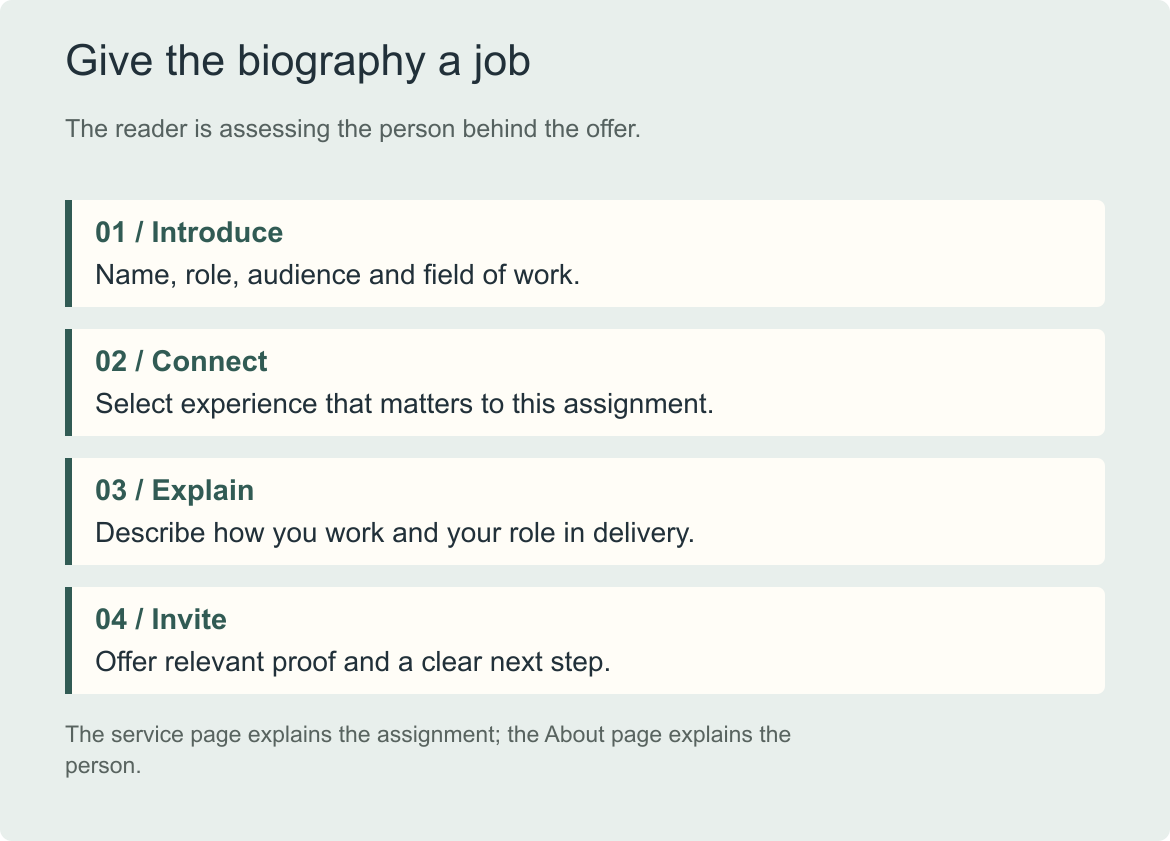
The page should make the relationship between the person, the work and the reader's decision visible.
Current credentials deserve a check before publication. Confirm names, dates, professional titles, memberships and any limits on how they can be described. Do not use a former employer's reputation to imply that it endorses your current practice.
Explain how it feels to work with you through specifics
Personality is useful when it helps someone understand the working relationship. Rather than describing yourself as collaborative, explain where collaboration happens. Rather than claiming to be practical, describe the kind of work a client takes away.
You might explain that an engagement begins with interviews, that recommendations are discussed with the people who will implement them, or that you work with the client's existing team. Use only the process you actually follow, and acknowledge where it changes with the assignment.
A buyer should also understand your role. Do you advise, facilitate, implement or provide continuing support? If you work with associates, explain how they contribute. A solo practice should not imply a large permanent team, and a collective should not leave the reader guessing who will lead their work.
This is one reason an About page needs a close relationship with the service pages. The biography introduces the person; the service page explains the assignment. They should support each other without repeating the same text.
A real example of giving experience context
The About page at Generate Impact brings together Dr. Rebecca Trobe's professional background, areas of practice and educational context. The useful lesson is the relationship between those elements: the page gives a reader ways to connect the founder's experience with the work described.
This is an example of professional presentation, not evidence that a biography alone produces enquiries. Our Generate Impact case study documents the website project; it should not be described as a separate personal-branding engagement.
Your own page may need far less detail. The appropriate length depends on the complexity of the service and what the prospective client needs to assess. The goal is a complete enough explanation, not a copy of another consultant's structure.

AI-generated illustrative photograph.
Illustrative generated photograph. Showing the person behind a practice helps a reader connect expertise with the work being discussed.
Use proof that belongs to the person and the practice
A relevant project account, an approved client comment, a published piece of thinking or a verifiable qualification can support the explanation. Choose evidence that answers the question a nearby paragraph raises.
For example, a section about facilitating difficult conversations might link to an approved description of that kind of assignment. A section about a specialist field might link to a substantive article you wrote on the subject. A testimonial should retain the meaning of the client's words and be used with the necessary permission.
Avoid borrowing credibility through a row of unexplained logos. A reader cannot tell whether a logo represents an employer, client, speaking event or membership unless you say. If you are permitted to identify the relationship, label it accurately. If you are not, choose evidence you can explain.
A lack of publishable client work does not require invented proof. You can show a clearly labelled fictional example to explain your method, or publish a useful account of how you approach a question. Keep that teaching material separate from claims about delivered client work.
Keep personal detail in proportion
A personal detail can make the introduction more human. It earns its space when it explains a perspective, establishes a meaningful connection or sounds like the person a client will meet.
You do not need to manufacture a dramatic origin story. Nor does every hobby belong on the page. Read the draft as a prospective buyer and ask whether the personal section adds useful context or distracts from the work.
The same restraint applies to photographs. A suitable portrait should be current enough to represent you, consistent with the level of formality of the practice and usable on a phone. You may also show a genuine working environment or a speaking setting if it is relevant and you have permission. A photograph of a large team should not imply that everyone pictured works in the business.
Rewrite the page around the buyer's decision
Return to the fictional engineering consultant. A weak version of the page might begin with childhood interests, list every role and end with “Let's transform your business.” A useful revision would change the order:
- Introduce the practice and the kind of firm it helps.
- Explain the experience most relevant to delivery problems.
- Describe the consultant's role and working approach.
- Offer appropriate evidence and a clear next step.
The career story still matters, but it now supports a decision instead of asking the reader to assemble the argument.

Original explanatory visual by Studio FLACH. Open the image to view it at full size.
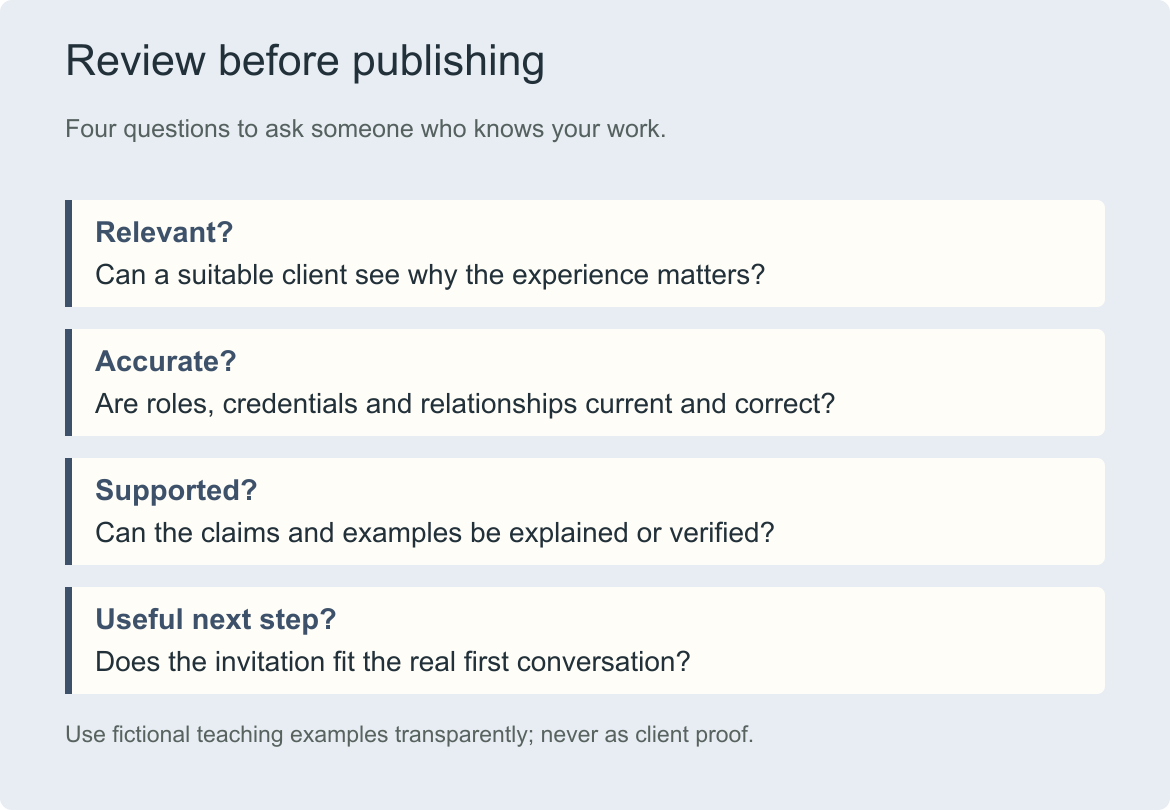
Use the review questions with someone who knows your work. Ask them to flag anything that sounds larger, broader or more certain than the practice can support.
End with a natural route into the work
Someone who has read the About page may be ready to investigate a particular service, read a relevant project account or start a conversation. Choose the invitation that fits your actual process.
“Contact me” can be enough when the context is clear. If a first conversation has a specific purpose, explain it. Avoid suggesting that sending a message commits someone to an engagement, or promising an immediate response when you do not provide one.
Before publishing, read the page next to your main service page. Do the audience, scope, people and invitation agree? Check every credential and link, then ask someone outside the practice to describe what they understood.
For the wider site structure, read our consulting website design guide . If your website needs to connect your experience with a clearer offer, explore True Space .