

Who writes the website copy? Copywriting, editing and copy direction explained
Clarify who supplies the facts, writes the first draft, edits the words, gives direction and checks the finished pages.

Agree who produces the first usable draft before the design starts. Writing, editing, copy direction, factual approval, and entering content into the site are different jobs.
A business owner says, “We have the content.” A designer hears, “The final words are ready.” A month later, someone opens the shared folder and finds presentations, a dated brochure, two biographies, and an email describing a service that has since changed.
The material may be valuable. It is simply not the same as approved website copy. The gap between those two things needs a person, a process, and time in the project.
The most useful question is not whether the owner or the studio should write everything. It is which parts of the content work each person will take responsibility for. An owner may know the service deeply and still need help shaping an explanation for someone encountering it for the first time.
Name the kind of writing help you are buying
These terms are used differently by different providers. Treat the following as a way to ask clearer questions, then confirm what your proposal means by them.
Copywriting usually means someone develops the words from source material and an agreed brief. Ask whether that includes interviews, the page structure, headlines, service descriptions, and supporting messages such as form confirmations. Establish the number of pages or content types covered.
Editing starts with a draft. It may improve clarity, organization, consistency, or sentence-level wording. A light edit of an otherwise sound page is different from rebuilding an explanation that does not yet identify the audience or offer. Show the editor the actual material before agreeing the task.
Copy direction helps someone else write. It may produce a page outline, message priorities, questions to answer, examples, or feedback on drafts. Direction can be valuable when the owner or a team member can write the copy. It does not automatically mean the adviser will turn every note into finished paragraphs.
Content entry means placing approved material into the website. It includes practical questions about formatting, links, images, captions, and which items will be loaded. It is not a substitute for writing or checking the claims.

Original explanatory visual by Studio FLACH. Open the image to view it at full size.
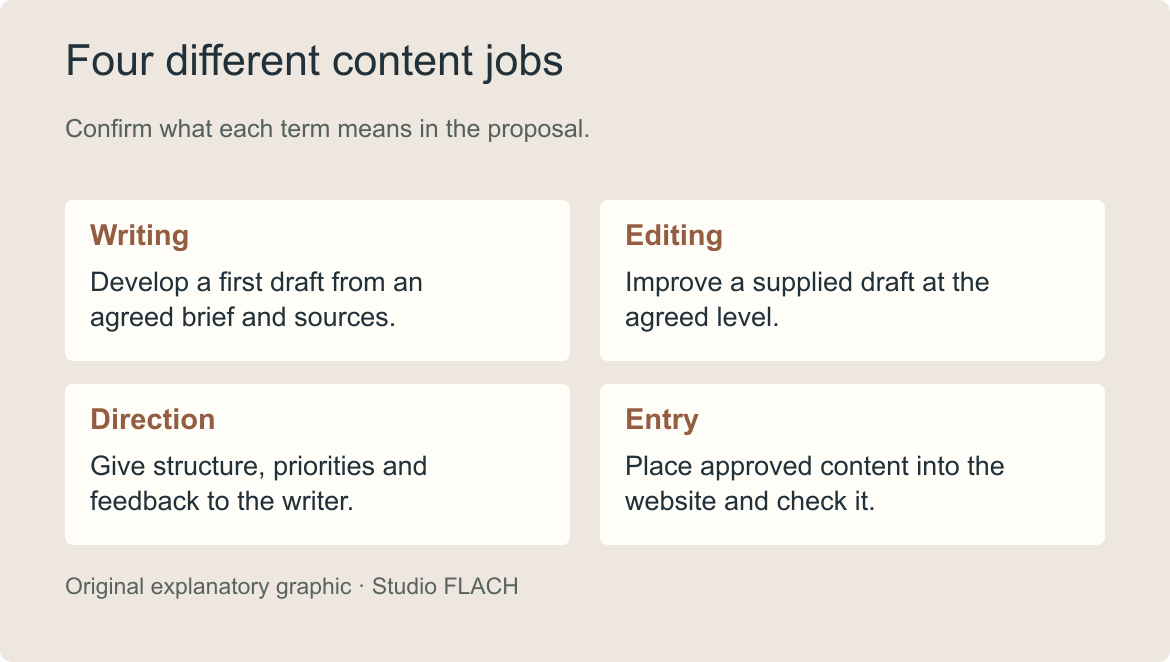
Use the descriptions to clarify your proposal. Different providers may use different labels for the same work.
The business still supplies the substance
An outside writer cannot reliably infer your actual process, limitations, credentials, or experience from a competitor's website. Give them the material needed to make a useful account of your business.
That does not mean handing over a perfectly organized archive. Start with the things you explain in sales conversations. What do people ask before they buy? Which projects fit? What must a client have ready? What changes the scope? What do you deliberately leave to someone else?
Bring evidence too. This could include an accurate service description, an approved quotation, a current qualification, or a project you have permission to discuss. Separate documented facts from aspirations. “We want to work with larger firms” is useful planning context; it is not proof that the firm already has that experience.
A writer can identify a missing explanation and ask a better question. Someone with the right knowledge inside the business still needs to answer it and approve the factual result.
A fictional example: three sensible ways to divide the work
Imagine a small operations consultancy introducing a new service. Its founder knows the work well but has no finished website draft. The project includes a service page, an updated About page, and a contact route. This is a constructed example, not a Studio FLACH client.
In a writer-led arrangement , the writer interviews the founder, reviews agreed source material, proposes a page structure, and produces first drafts. The founder checks service details and evidence. The designer responds to the approved structure, and the team refines the text in context.
In an owner-draft arrangement , the adviser supplies an outline and prompts. The founder produces a draft by an agreed date, then an editor helps clarify and organize it. This can work when the founder has time and writes comfortably. It is less suitable if the writing task keeps being postponed between client commitments.
In a direction-only arrangement , the adviser defines the questions and priorities, but the founder's team writes, edits, and approves the final copy. That is a substantial internal commitment. It should be visible in the schedule and budget, even if the external proposal has a smaller writing line.
None of these approaches is inherently the correct one. The useful choice is the one that matches the complexity of the message, the quality of the source material, and the capacity of the people doing the work.
Agree what “ready for design” means
You do not need every comma settled before anyone explores a layout. You do need enough substance to design around the real message. The page's purpose, audience, important content, supporting evidence, and next step should be understood.
For example, a service page that may need an explanation of the process, an example, pricing context, and a question section cannot be planned responsibly around one generic introductory paragraph. Discovering those requirements late can change the layout as well as the writing task.
Copywriter Robyn Bradley describes the value of the writer and designer working together in her guide to website copywriting services . For your project, translate that collaboration into an agreed sequence: who proposes the structure, who drafts, when the designer sees the material, and who resolves changes.
Use our design brief template to establish the business context before those page-level decisions begin.

AI-generated illustrative photograph.
Illustrative generated photograph. A useful interview draws out the business knowledge that the website needs to explain.
Make approval manageable
Choose one person to collect comments. Other people may need to verify specific facts, but the writer should not have to reconcile contradictory instructions arriving through several channels.
Separate three kinds of feedback. First, correct what is factually wrong. Second, identify what a reader may not understand or what the page has omitted. Third, discuss preferences about expression. Naming the reason behind a change makes it easier to find a good solution.
“We cannot promise that delivery time because it depends on client approval” gives the writer useful information. “Make it more confident” does not explain which part is inaccurate or unconvincing. It may accidentally encourage a stronger promise than the business can support.
Read the main page copy together with its links, buttons, and form messages. A page that promises a consultation should lead to the right action and explain what happens after it. Approval of a text document alone does not check that relationship.
Ask these questions before the project is scheduled
- Which pages and supporting messages need writing, and what is already approved?
- Who turns the source material into the first draft?
- Are interviews and research included, and with whom?
- Is the work writing, editing, direction, or a combination?
- Who verifies claims, permissions, credentials, and service details?
- Who consolidates feedback and gives final approval?
- Who enters the content and checks it in the built site?
- What happens if the service or audience changes after a draft is approved?

Original explanatory visual by Studio FLACH. Open the image to view it at full size.
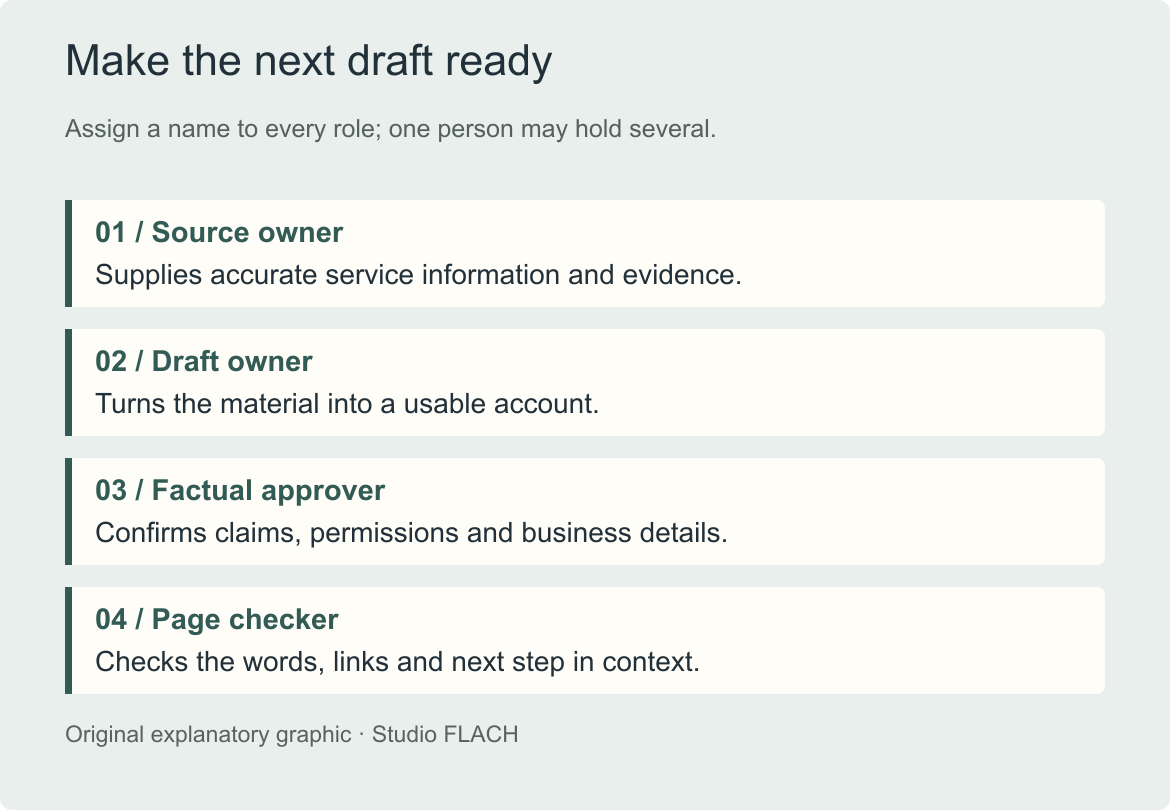
Assign a name to each role. One person may hold several roles, but no role should depend on an unspoken assumption.
Keep a usable source of truth after launch
The content process continues when a service changes, a person joins, or a qualification expires. Decide where approved information lives and who can make routine corrections. A simple shared record of current service descriptions and evidence can save the next update from beginning with another search through old decks.
If you use AI to help prepare a draft, keep the same responsibilities. Someone must check the account of the business, remove invented experience, confirm permissions, and decide whether the text helps the intended reader. A fluent draft does not establish that any of its factual claims are true.
True Space includes copywriting or copy direction within the agreed project scope. Use the current scope description as a starting point, then agree which route your project needs and what your team will supply. The clearest arrangement leaves everyone able to answer one practical question: who makes the next draft ready?