

What should a small business budget after its website launches?
Separate platform charges, connected tools, care and new work so your operating budget reflects the arrangement behind the total.

The project invoice tells you what it costs to create the website. Your operating budget needs to explain what it costs to keep the site available, accurate and useful after launch.
Those are related decisions, but they are not the same purchase. A small consultancy with a hosted website and occasional updates may need a very different arrangement from a business running appointments, payments, frequent campaigns and several connected services.
A useful budget separates the underlying services from the human work. That lets you see what must be paid to keep the current site functioning, what is needed to maintain it responsibly and what you are choosing to invest in improving it.
Divide the budget into four categories
Start with the actual website setup. Ask the person who built or manages it to identify each recurring service and its purpose. Then group the costs so you can compare the arrangement without confusing a platform subscription with a support agreement.
Category: Core running services; What it might include: Domain registration, hosting or website-platform plan; What to ask: Who pays, when does it renew and what does the plan cover?
Category: Connected tools; What it might include: Scheduling, forms, email marketing, payments or specialist integrations; What to ask: Is the tool needed, and is its cost fixed, usage-based or transaction-based?
Category: Technical care; What it might include: Checks, backups, updates or fixes appropriate to the setup; What to ask: Which tasks have an owner, and what is excluded?
Category: Business improvements; What it might include: New pages, revised content, campaigns and design work; What to ask: What work is planned, and how is extra scope approved?
One provider may cover several categories. A hosted platform may include functions that would otherwise need separate arrangements. A support package may combine maintenance and new work. Record the boundaries so you do not pay twice for the same responsibility or assume a task is covered when it is not.

Original explanatory visual by Studio FLACH. Open the image to view it at full size.
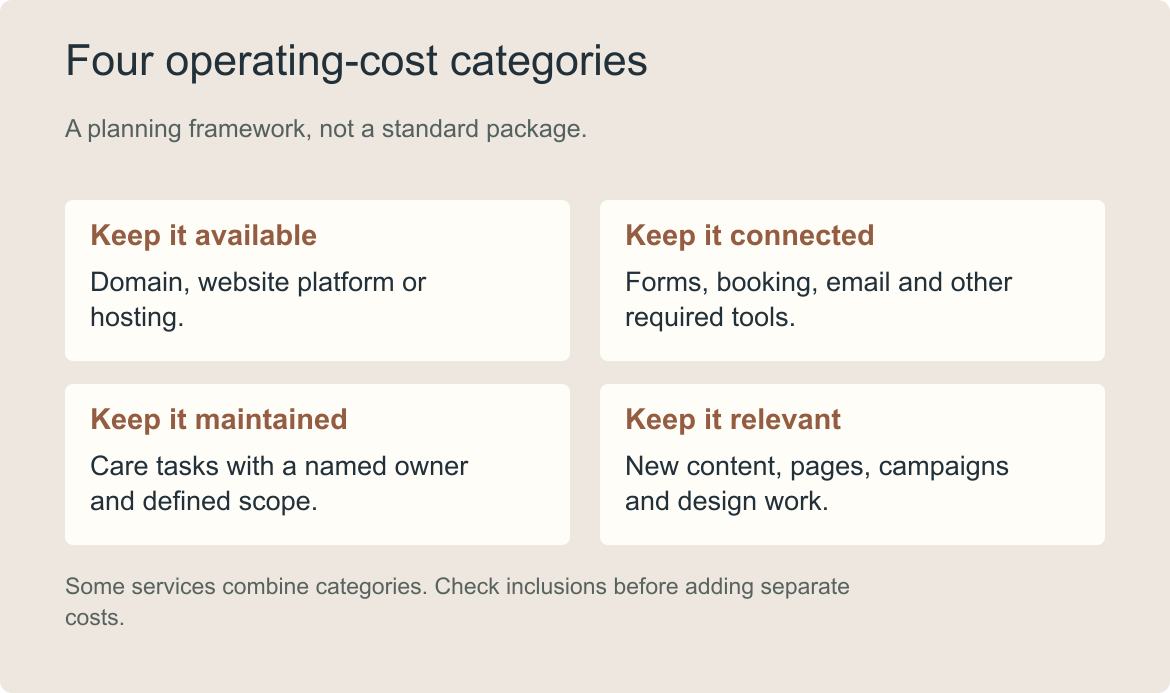
The categories are a planning framework. The actual tasks and costs depend on your platform, connections and support agreement.
Check renewals before calculating a monthly average
A domain might renew annually while the website platform is billed monthly or annually. Another tool might charge according to contacts, usage or transactions. A simple monthly total can hide the dates when cash actually leaves the business.
For each service, record the normal renewal amount, currency, billing interval, next payment date and the person who receives the notice. Distinguish a promotional first term from a later renewal price. Note applicable taxes and any currency-conversion costs rather than assuming the price on a marketing page is the amount on your invoice.
Do the first pass from your own invoices and account settings. If you are comparing a new platform, confirm the current plan and the functions you need before entering a figure. A low advertised entry price may describe a different configuration from the one proposed for your business.
Keep both views: the monthly planning equivalent and the actual payment schedule. The first helps compare options; the second helps you manage cash and avoid missed renewals.
Decide which tools earn their place
An integration can be valuable when it removes a real step from the work. It can also become a forgotten subscription after a campaign or an abandoned experiment.
Ask what each connected service does today. A booking tool may be essential because clients choose a time before making an enquiry. An email tool may support a regular newsletter. A paid form service may be part of the website's enquiry route. Removing any of those without checking could interrupt the process you rely on.
For tools you no longer use, plan the exit first. Establish whether you need to retain records, export information, replace an embedded element or change a connection. Cancelling the payment is not always the same as removing the dependency.
This review should lead to a smaller, clearer inventory, not an automatic rule to choose the cheapest stack. A tool that your team can manage reliably may be a better fit than a cheaper collection of services nobody understands.
Describe technical maintenance as actual work
“Maintenance included” is not a complete scope. Ask what will be checked, how often, who responds to an issue and what happens when fixing it requires work outside the agreement.
The answer will vary with the setup. A hosted platform and a separately hosted content-management system do not have identical responsibilities. Ask the provider to explain which parts it manages and which parts remain with your business or another supplier.
Useful questions include whether the arrangement covers updates, backups and recovery, form checks, broken links, failed integrations or investigation after an alert. Do not assume that every maintenance agreement includes every task, an immediate response or continuous monitoring.
The same applies to restoration. If a backup is part of the plan, ask what it contains and how recovery would be requested and checked. An untested assumption about recovery is difficult to price because nobody knows what assistance would be needed.

AI-generated illustrative photograph.
Illustrative generated photograph. Continuing care has a defined purpose: keeping something people rely on ready for ordinary use.
A fictional operating budget
Consider a fictional consultancy with a small website, a newsletter and an external booking tool. The following figures are invented for illustrating the calculation. They are not quotes, market averages or Studio FLACH package prices.
Item: Domain renewal; Fictional cost: $24 per year; Monthly planning equivalent: $2
Item: Hosted website plan; Fictional cost: $360 per year; Monthly planning equivalent: $30
Item: Email-marketing tool; Fictional cost: $25 per month; Monthly planning equivalent: $25
Item: Booking tool; Fictional cost: $15 per month; Monthly planning equivalent: $15
Item: Defined support allowance; Fictional cost: $240 per month; Monthly planning equivalent: $240
Item: Total; Fictional cost: $3,744 per year; Monthly planning equivalent: $312
The annual calculation is $24 + $360 + ($25 + $15 + $240) × 12. It assumes these services remain unchanged for a year and excludes taxes, transaction fees, currency conversion and additional project work.
This consultancy would also keep the annual domain and website payment dates in its cash plan. The $312 figure is an average, not necessarily the amount paid in any one month.
Now consider a proposed new campaign. If the support allowance covers only specified care tasks, a new campaign page may need a separate quote. If it includes a defined capacity for changes, the page may need prioritising against other requests. The cost question is inseparable from the scope question.
Keep maintenance and growth work visible
Updating an outdated team biography, adding a new service and creating a campaign landing page all help the site stay relevant. They are not automatically routine technical maintenance.
Give the business a small forward plan. What is likely to change this quarter? Is there a new offer, event, team member or case study? Which changes have a deadline, and which can wait? This gives a studio enough context to advise on separate projects or continuing support.
Studio FLACH's Next Step service can include ongoing website care and updates alongside design and marketing work. Requests are prioritised within the agreed monthly capacity, and fit is confirmed before work begins. That description should not be read as an automatic promise of every technical-care task or round-the-clock emergency response.
Our graphic design retainer guide explains the wider decision about ongoing capacity. Your operating budget should still identify platform charges and responsibility boundaries separately.

Original explanatory visual by Studio FLACH. Open the image to view it at full size.
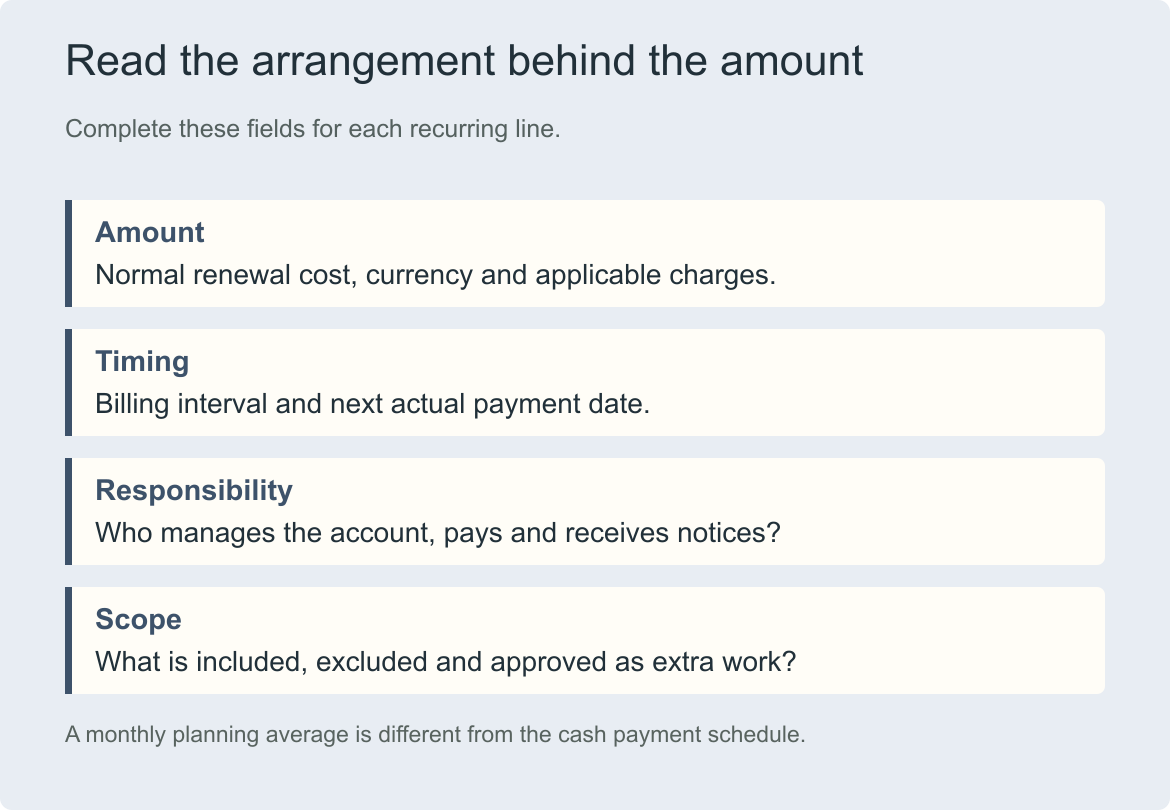
A useful budget gives you the amount and the arrangement behind it. Record what changes the cost and who decides when that happens.
Review when the business changes
Return to the budget when you add a tool, change the platform, launch a substantial offer or renew a support agreement. An occasional review can also reveal services that are still billed to a former employee or a payment card that is about to expire.
The goal is not to eliminate every recurring expense. It is to know which expenses keep the current system running and which buy the work your business needs next.
Bring your existing invoice list, the account inventory and the next few planned changes to a support conversation. If your business needs continuing design and website help, explore Next Step . A clear scope gives both sides something more useful to discuss than an unexplained maintenance total.