

How to use client testimonials when you cannot publish the full project
Use approved, specific client feedback without revealing restricted project details or implying results you cannot substantiate.

You can explain why clients trust your work without publishing everything you did for them. A useful testimonial may describe how you listened, clarified a difficult decision, led the process or prepared a deliverable. It does not need to reveal a confidential strategy, identify an unannounced transaction or claim a financial result you cannot substantiate.
The useful question is: what can this client genuinely say, and what have they agreed you may share? That produces stronger evidence than trying to disguise a complete case study behind a vague company description.
For consultants and other service firms, confidentiality is part of the work. Your website can respect that responsibility and still give a prospective client something concrete to assess.
Start with the boundary, then choose the proof
Before requesting a quote, review the project's confidentiality terms and any publicity restrictions. The person who enjoyed working with you may not be authorized to approve a company name, logo, quotation or project description. Ask who can approve public use rather than assuming a friendly email settles every permission.
Make a short inventory of what you want to show. A client's name, job title, portrait, employer, logo and quoted words are separate pieces of information. Permission to publish a sentence does not automatically mean permission to use a portrait beside it or describe the sensitive work behind it.
Then choose the least revealing evidence that still helps the buyer. If the question is whether you communicate clearly, a specific comment about the review process may answer it. If the question is whether you can deliver a particular technical service, a general compliment about friendliness will not establish that capability. Use an approved deliverable description or an inspectable example of your own method instead.

Original explanatory visual by Studio FLACH. Open the image to view it at full size.
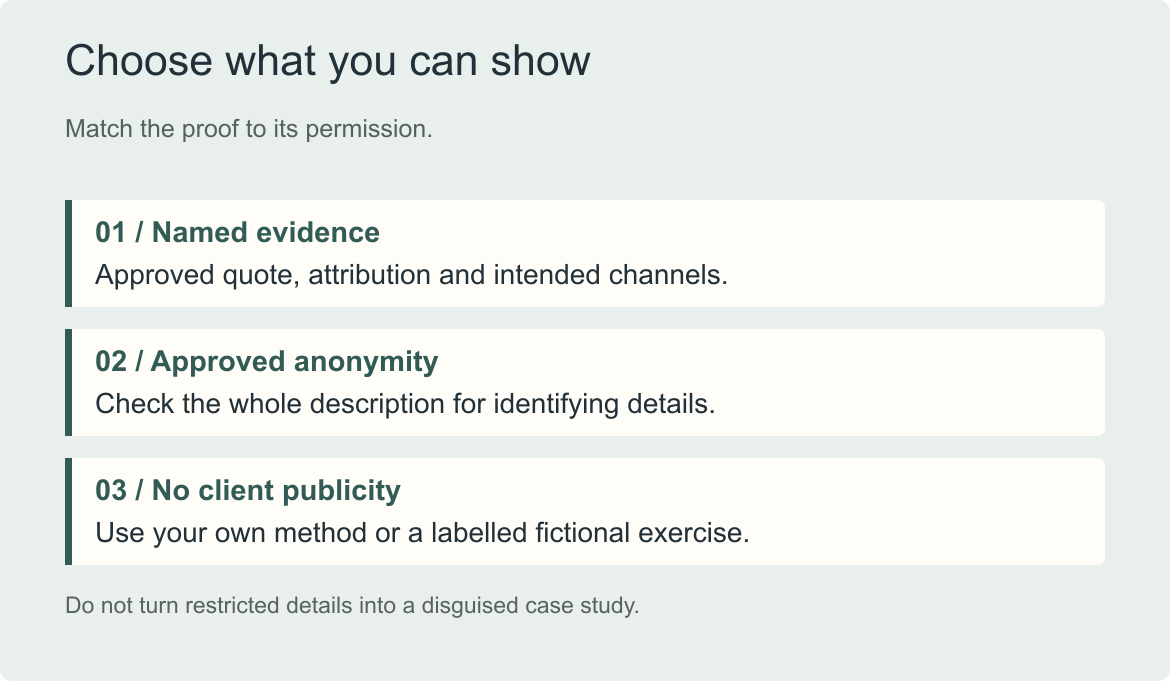
Choose the evidence that the client can approve. Do not treat anonymization as permission to reveal restricted work.
Ask for an observation, not an endorsement script
A request such as “Please say we transformed your business” pressures the client towards a result you have already chosen. Better questions invite their own observations:
- What were you uncertain about before the project?
- Which part of the process helped you make a decision?
- What was different about receiving or using the finished work?
- What would another business owner find useful to know before working with us?
The client may answer only one. That is enough if it provides a truthful, relevant detail. You can suggest a shorter version of a long answer, but send the proposed wording back for approval. Keep the meaning intact, including any condition that matters.
For US-facing marketing, the FTC's endorsement and review guidance is a useful starting point: testimonials need to reflect genuine experience, and advertising must not create a misleading impression. A polished quote is still an advertising claim. Permission to publish it does not prove that every result it implies is typical or supported.
Make the permission request easy to answer
Show the exact material and placement you are proposing. “Can we use your feedback?” leaves too much unstated. A more useful request looks like this:
May we publish the wording below on our website's service page and in a future proposal? We propose crediting it to your first name and role, without your company name. Please tell us whether that attribution is acceptable, whether any detail should be removed, and who else needs to approve it. We will use only the final wording and attribution you approve.
This is a sample request, not a legal release. Adapt it to the relationship and the agreement governing the work. If you also want social use, include that in the request. If the client approves website use only, record that limitation where your team can see it.
Keep the final approved wording, attribution, permitted channels, approver and approval date together. A designer should not need to reconstruct permission from a long email chain when the quote is reused six months later.
Specificity can come from the process
Consider these fictional examples. Neither describes a real client or verified Studio FLACH outcome.
Too vague: “A brilliant team. Highly recommended.”
More useful: “They turned our scattered service notes into a page structure we could review together. We knew what needed a decision at each stage.”
The second statement gives a buyer a way to picture the collaboration. It describes an observable process rather than claiming an increase in sales. That makes it relevant to an owner worried about becoming stuck in revisions.
A different fictional client might say, “We could update the team biographies ourselves after the handover.” That can support an editing-autonomy discussion if it accurately describes the project. It would not support a claim that every website is easy for every client to maintain.

AI-generated illustrative photograph.
Illustrative generated photograph. It does not depict a client meeting or the source of a testimonial.
Anonymized does not always mean unidentifiable
“Finance director at a regional firm” may sound anonymous. Add a distinctive project date, acquisition detail and small location, however, and the description may identify the organization to anyone familiar with it.
Review the combination of details. Ask whether the client is comfortable with the whole presentation, including the surrounding case-study text and images. If a description must become so broad that it no longer helps a buyer, choose another form of evidence.
Useful alternatives include an original worksheet showing your process, a clearly labelled fictional example, a public deliverable the client has approved you to show, or your own explanation of how you review work. Keep the labels visible. A fictional exercise should never acquire a client-like name, logo and quotation that makes it appear to document a real engagement.
An approved anonymous testimonial can be valuable, but readers have fewer ways to verify its source. Do not compensate by adding invented precision or an implied company endorsement. Give it an honest attribution, and let other inspectable evidence carry part of the trust.
Place the comment beside the question it answers
A testimonial about clear communication belongs near a description of the project process. A comment about useful presentation templates belongs near the relevant deliverable. This gives the reader context without forcing a generic praise carousel onto every page.
Introduce enough of the engagement to make the quote understandable, within the approved boundary. Avoid headings that strengthen it. A quote about an organized handover under “Clients who doubled their revenue” would imply a result the words never establish.
Also distinguish personal experience from company endorsement. If a former employee speaks about work they experienced, check the proposed role attribution and permission rather than using their former employer's logo to suggest the organization has approved the statement.

Original explanatory visual by Studio FLACH. Open the image to view it at full size.
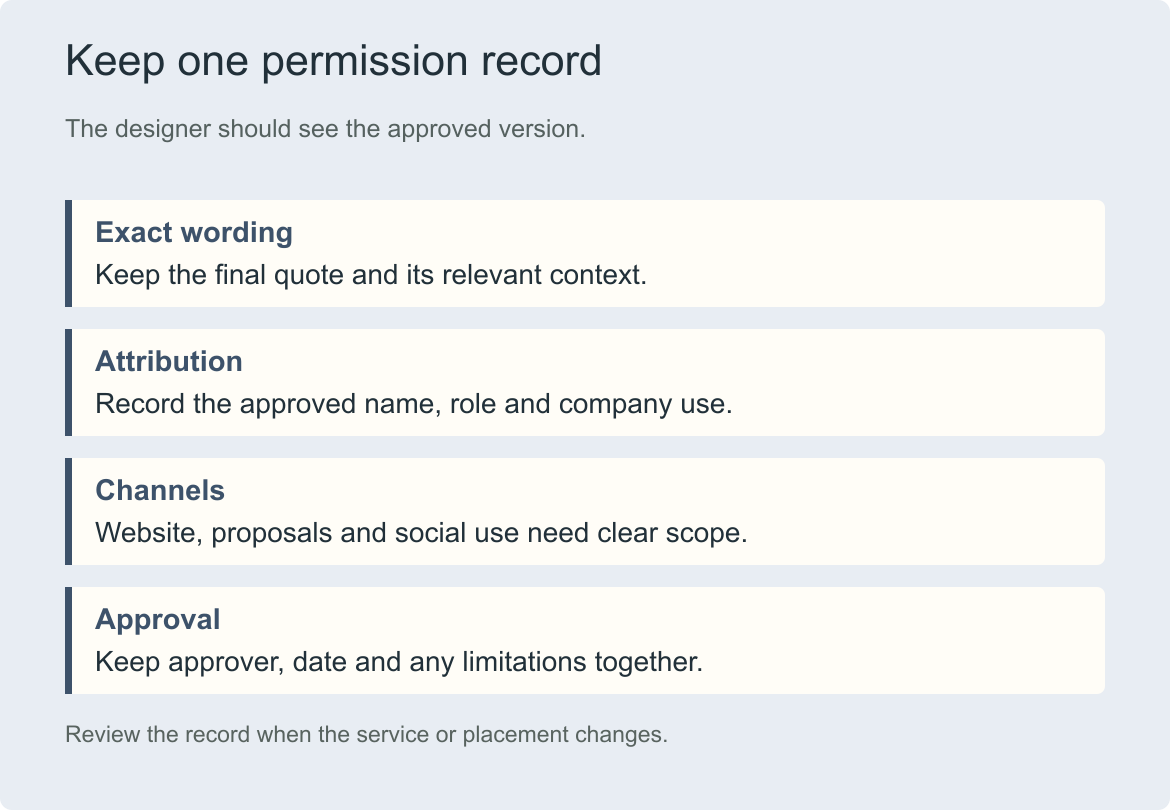
A small evidence record helps the same approved meaning survive design, editing and reuse.
Review the evidence when the website changes
Testimonials can become misleading through surrounding changes even when their wording stays the same. A comment about a small website update should not silently become evidence for a newly advertised full-service marketing engagement.
At each substantial website review, check that the quote still describes the relevant service, the attribution remains accurate, and the permission covers its current use. If the client has requested a change, update your source record as well as the visible page so the older version is not accidentally reintroduced.
You do not need a quote for every claim. Sometimes the better next step is to explain the service more clearly or show the work you are authorized to show. Our guide to service-business case studies develops that broader structure: context, decisions, deliverables and evidence you can support.
When a brand and website project is being planned together, Signature Suite gives those evidence decisions a place in the wider presentation of the business. Bring the material you can use, the restrictions you need to respect and the questions buyers still ask. A truthful, well-placed piece of proof is more useful than a larger story you cannot responsibly tell.