

Should a service business put prices on its website?
Choose between a fixed fee, starting price, range and quote process based on what your service can define reliably.

Publish enough pricing information to help a suitable customer make a decision. The right format depends on how reliably you can define the work before speaking to them.
A visitor is interested in your service and wants to know whether it belongs in their budget. Your team wants to understand the project before giving a figure. Both needs are reasonable. A useful pricing page helps the visitor move forward while making the conditions behind the number clear.
That may mean an exact fee, a genuine starting price, a range, a set of packages, or an explanation of what determines a quote. The decision should follow the service you actually deliver. Copying the pricing format of an unrelated business can create expectations you cannot meet.
The aim is a more informed conversation. Publishing prices does not guarantee more enquiries, a better close rate, or a particular revenue result.
Begin with what you can define reliably
Choose one service rather than deciding the policy for the entire business at once. Ask what is consistent between jobs and what must be understood before you can quote.
A fixed appointment with an agreed duration and output is different from an open-ended consulting engagement. A recurring service with clearly defined limits is different from work that depends on a building's condition, a client's systems, or an unknown volume of material.
Write down the usual scope, the genuine minimum commitment if there is one, the factors that change the work, and the information needed to confirm the price. You now have the basis for choosing a format. If your team cannot agree what the amount includes, publishing the amount will not resolve that uncertainty.
Choose a price format that matches the service
A fixed fee for a defined job
A fixed fee is useful when the buyer can understand the boundaries before purchasing or enquiring. Describe the deliverable, relevant limits, and anything the customer must supply. State what happens if the work falls outside those limits.
The price and the scope need to travel together. A prominent figure followed by an obscure list of essential extras asks the reader to reconstruct the real offer. Make the practical commitment understandable near the price.
A starting price with an honest explanation
A starting price can establish the minimum investment for a service with variable scope. It needs to represent work someone can actually buy, with a description of what changes the final amount.
Ask whether a prospective customer would understand what the starting amount covers. If nearly every ordinary project needs substantial additions, the lowest number may be less useful than a realistic description of typical scope and the quote process.
A range grounded in real work
A range can help when the main variations are understood but the exact scope still needs a conversation. Explain the factors behind it and how the business will confirm the actual quote.
Do not invent a reassuring range because a page feels incomplete. Review real work and current costs internally. If the service is new, be clear about the limits of what you can estimate instead of presenting a guessed range as established experience.
A quote process with useful context
Some services need more discovery before an amount is meaningful. A quote-only approach can still explain the information needed, the factors affecting scope, any genuine minimum commitment, and the next step.
“Contact us for pricing” gives little help on its own. “Tell us the number of locations, the work required, and your intended timing; we will review the scope before quoting” gives the customer a clearer task. Add a response expectation only if the business can support it.

Original explanatory visual by Studio FLACH. Open the image to view it at full size.
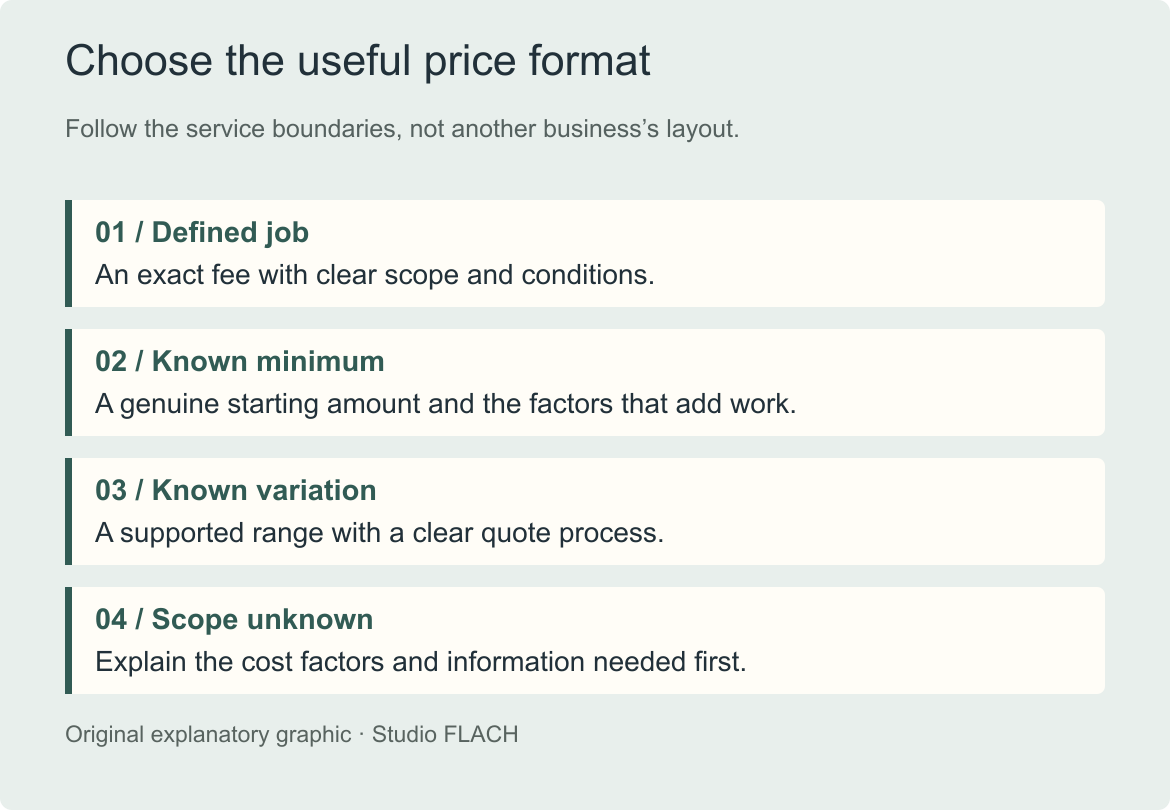
Choose the format from the service's real boundaries. A business can use different formats for different services.
Three fictional examples
The following examples are constructed to show the decision. They are not customer offers, market prices, or conversion results.
An independent consultant offers a defined review with an interview, a fixed set of materials, and a written set of recommendations. A fixed fee could be understandable if the page explains those boundaries. Follow-on implementation can be scoped separately rather than implied as part of the review.
A specialist training business offers workshops whose preparation changes with audience size, delivery format, and customization. It might explain those cost factors and provide a genuine starting point or range when its own current records support one. The page should distinguish the workshop from travel or other separately arranged requirements where relevant.
A small maintenance business cannot price an unfamiliar job responsibly without understanding the equipment and condition. It can still explain how assessment works, what information helps, and whether an initial assessment has a charge. The absence of a complete fee list need not mean the absence of useful price context.
The common decision is how much can be promised before the business knows more. That is a scope question as well as a presentation question.
Consider the trade-offs in your own sales process
Visible pricing may help someone recognize that a service fits their budget. It may also lead them to compare an amount without noticing the work behind it. A starting price may answer an initial question but anchor the conversation to the least expensive scope. A quote-only route allows more discussion but leaves the visitor with less information before contacting you.
Treat those as possible effects to investigate. Do not assume that publishing a number automatically improves lead quality or that hiding it automatically creates better conversations. Your traffic, service, audience, and follow-up all matter.
Squarespace's pricing-page guide discusses several ways to present prices, including packages and starting amounts. Use that variety as permission to choose a useful format for your service. You do not need to imitate a software subscription page if your work is sold through a different decision process.

AI-generated illustrative photograph.
Illustrative generated photograph. The website should give someone enough context to arrive with a more informed question.
Put the explanation beside the amount
Give the reader the essential context while they are considering the price. Explain what is included, what changes the scope, what remains separate, and what happens next. If the amount repeats, make that clear. If a commitment or condition is material, do not rely on a visitor discovering it much later.
For US businesses, the Federal Trade Commission's small-business advertising guidance says advertising must be truthful and non-deceptive and that advertisers need support for their claims. It also explains that material omissions can be misleading. This article does not determine the requirements for your industry or state; obtain appropriate advice when the pricing arrangement needs legal review.
Use your real offer to test the page. Could a reasonable prospective customer explain what they receive and when the amount might change? Could your team honour that explanation without adding an important condition during the first call?
Review the page as part of a buyer's journey
Price information does not have to live on an isolated page. A service page can provide context at the point someone is evaluating the work, then link to a fuller explanation where needed. Make the next action match the level of certainty: book a defined service, provide information for a quote, or discuss whether a broader engagement fits.
Our service-page guide explains how those decisions connect with scope, evidence, and the next step. The price section should help that account of the service rather than contradict it.

Original explanatory visual by Studio FLACH. Open the image to view it at full size.
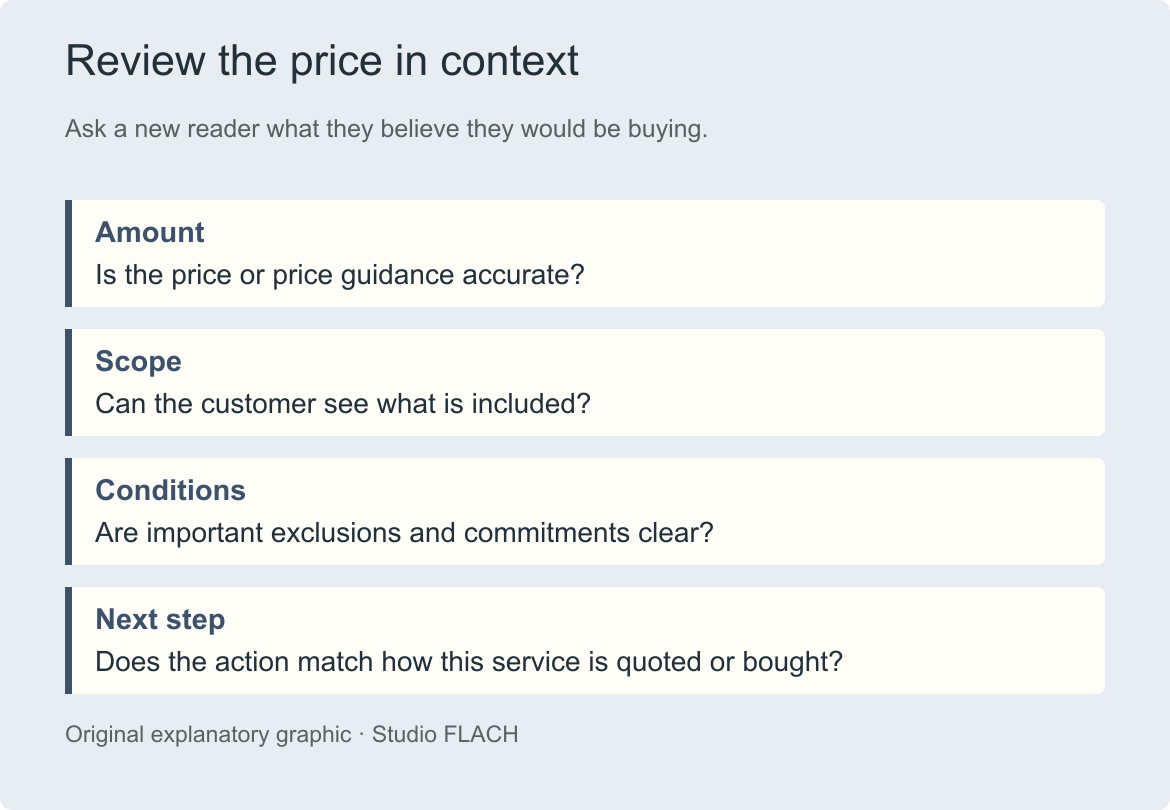
Read the amount and its conditions together. Ask someone unfamiliar with the service what they believe they would be buying.
Check whether the change is useful
After changing the page, record the date and review the questions people ask. Are suitable prospects arriving with a clearer understanding? Are they confusing a starting amount with a complete quote? Is your team repeatedly explaining an exclusion the page could state more clearly?
If you have reliable enquiry and sales records, compare equivalent periods with enough context to interpret them. A change in raw enquiry count alone does not establish whether the page is working better. The enquiries may differ in fit, and demand may have changed at the same time.
At Studio FLACH, the pricing page places defined project fees alongside their scope and distinguishes them from monthly support. It is one real example of explaining the commitment, not proof that the same model suits every service business. When a website needs a clearer account of the offer and how to buy it, True Space is the place to begin a scope conversation.