

How to compare website redesign proposals before choosing a studio
Read proposals as responsibility documents: compare the work, exclusions, approvals, ownership and costs before choosing your web partner.

A useful comparison shows who is responsible for the work, what you will receive, and what remains yours to arrange. The total price only makes sense alongside those answers.
You have explained the same website problem to three providers. The proposals arrive with different prices, different page counts, and three versions of the phrase “everything you need.” One includes writing. One asks for final content. Another describes strategy without saying what that produces.
You do not need to become a web designer to compare them. You need a common description of the job and a clear account of what each provider has agreed to do. A lower fee may be a good choice when your team can supply the missing work. It becomes a problem when nobody has noticed that the work is missing.
This guide is for the business owner reading proposals. It will help you turn polished documents into a decision you can explain to a colleague, partner, or future self.
Give every provider the same job to respond to
Before comparing the offers, write a short description of the project you actually need. Name the reader the site must serve, the main services it must explain, the evidence you can publish, and the action a visitor should be able to take. Add any requirements that make the work less straightforward, such as moving an article archive or connecting a booking tool.
Your first brief does not have to solve the design. It needs to make the business situation visible. “We need a contemporary website” leaves almost everything open. “We need to explain two consulting services, introduce a specialist team, publish approved project examples, and receive the right enquiry information” gives a provider something to respond to.
Use our design brief guide if those decisions are still scattered across notes and emails. Then send the same starting information to everyone. If a provider recommends a different approach, ask them to explain the change rather than quietly comparing a different job.
Translate promises into outputs and owners
Take a sentence from each proposal and ask three questions: what does this produce, who does it, and how do we know it is complete?
“Content support” might mean a workshop and outline. It might mean editing text you supply. It might include interviews and complete first drafts. Those can all be useful services, but they leave very different responsibilities with your team.
The same applies to “launch support.” Does someone connect the domain, test the enquiry route, check agreed old URLs, and explain routine updates? Or does the engagement finish when a working site is handed to someone else? Put the answer in the comparison before deciding that two proposals offer the same thing.
For every important task, use one of four labels: included, supplied by us, separately priced, or unresolved. Resist turning an unresolved answer into an assumed inclusion. A short clarification now is easier to work with than a disagreement close to launch.

Original explanatory visual by Studio FLACH. Open the image to view it at full size.
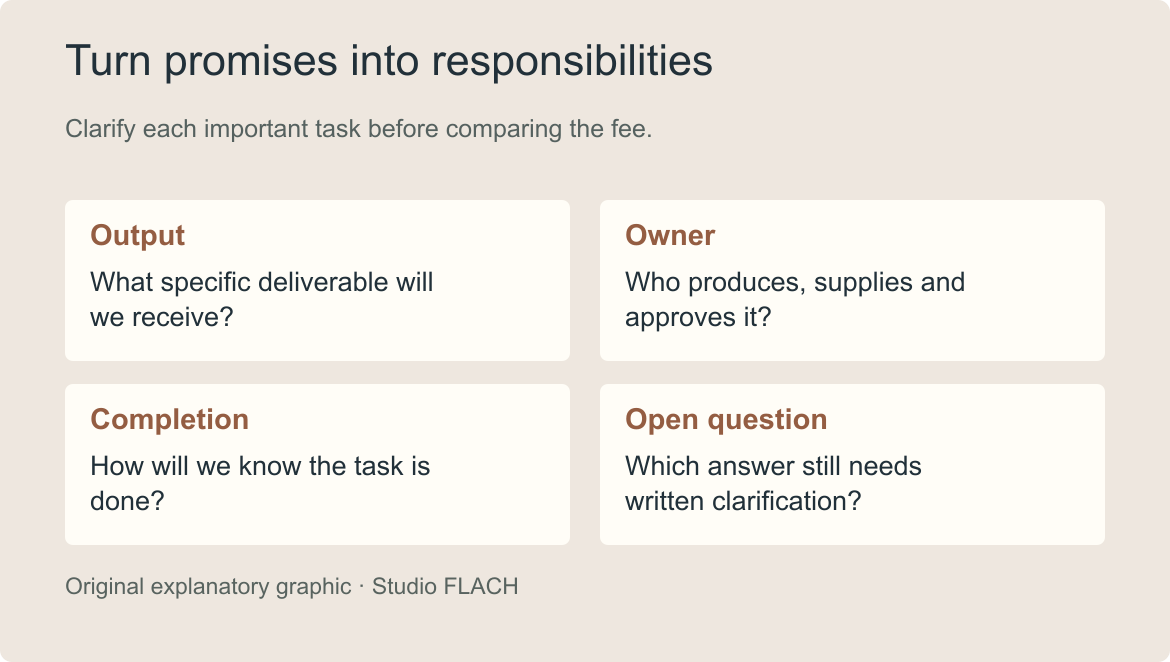
Give each important promise an output and an owner. Mark an unanswered question as unresolved rather than treating it as included.
Compare a fictional pair of proposals
Consider a fictional operations consultancy replacing a five-page site. Its owner wants clearer service descriptions, three team biographies, and a way to publish project examples. The firm has old slide decks and interview notes, but no approved website copy.
Provider A includes a sitemap, two reusable page layouts, responsive development, a contact form, and training. The firm must supply approved text and photographs. Existing articles and search migration are outside the stated scope.
Provider B includes interviews, page planning, first-draft copy, more page types, development, content entry for an agreed number of items, a URL review, launch checks, and training. The firm still approves factual claims and supplies permission to use client material.
There is no fee in this example because the first task is to understand the difference. A could be suitable if the firm has a capable writer, a simple archive, and someone to handle migration separately. B could be suitable if the owner needs those responsibilities coordinated within the project. Neither description establishes quality, value, or a likely business result on its own.
Now imagine that the owner tells A to add interviews, copywriting, and archive work. A revised proposal may become more comparable. It may also reveal that the provider does not offer those tasks. Both answers are useful before the firm commits.
Read the parts that are easy to overlook
Page types and content entry
“Ten pages” could describe ten individual designs or ten entries using one layout. Ask what is unique, what is reusable, and how many entries someone will actually enter. A case-study system with one example loaded is different from an archive of thirty checked projects.
Include the less glamorous parts of the experience: form confirmations, empty states, downloads, team biographies, and the publishing fields your staff will use. They are part of the website even when they are absent from a homepage presentation.
Revisions and changed requirements
Understand the review stages, who consolidates feedback, and what happens when a requirement changes. Refining an agreed layout is different from adding a second audience and a new service halfway through development.
Ask how extra work is described and approved. You need a process you can use, not an assumption that every future request is included or that every question will trigger an additional bill.
Search, integrations, and testing
Ask what “SEO” includes. Page settings, redirect planning, research, ongoing content, and external promotion are separate activities. A defined search setup is a deliverable; a promised position on Google needs much more scrutiny.
For integrations, identify the exact tool, intended information flow, test, and account owner. “Connect the CRM” is incomplete until you know what happens after a visitor submits the form and who checks that it arrived.

AI-generated illustrative photograph.
Illustrative generated photograph. Proposal questions are easier to resolve when the people approving the work share the same understanding of the scope.
Ownership and life after launch
Ask whose accounts will hold the domain, platform, analytics, and subscriptions. Establish what files and access you receive, what your team can change, and what continuing support includes. Some assets or software may remain subject to third-party licences; do not treat “you own the website” as an answer to every access or licensing question.
Our redesign cost guide separates project fees from preparation and running costs. Use that distinction when one proposal includes hosting or support and another leaves them separate.
Use the meeting to examine their thinking
A proposal comparison is incomplete without talking to the people who will do the work. Ask them to explain one recommendation in relation to your business. Why this page structure? Why this content approach? Why keep or replace the current platform?
Orbit Media's guide to choosing a web designer includes questions about understanding the business and discussing a real page. That is a useful direction for your conversation: ask for reasoning you can follow, rather than relying only on presentation quality.
You can also ask how a comparable challenge was handled in a documented project. Review the live work where available. Distinguish a provider's actual contribution from the wider work of its client, and do not infer revenue results from an attractive portfolio.
Make a decision record you can use later
Keep the final comparison short enough to revisit during the project. Record the agreed requirement, each provider's answer, outstanding clarifications, and the reason the requirement matters. Attach written answers or ask for a revised proposal when an answer materially changes scope.

Original explanatory visual by Studio FLACH. Open the image to view it at full size.
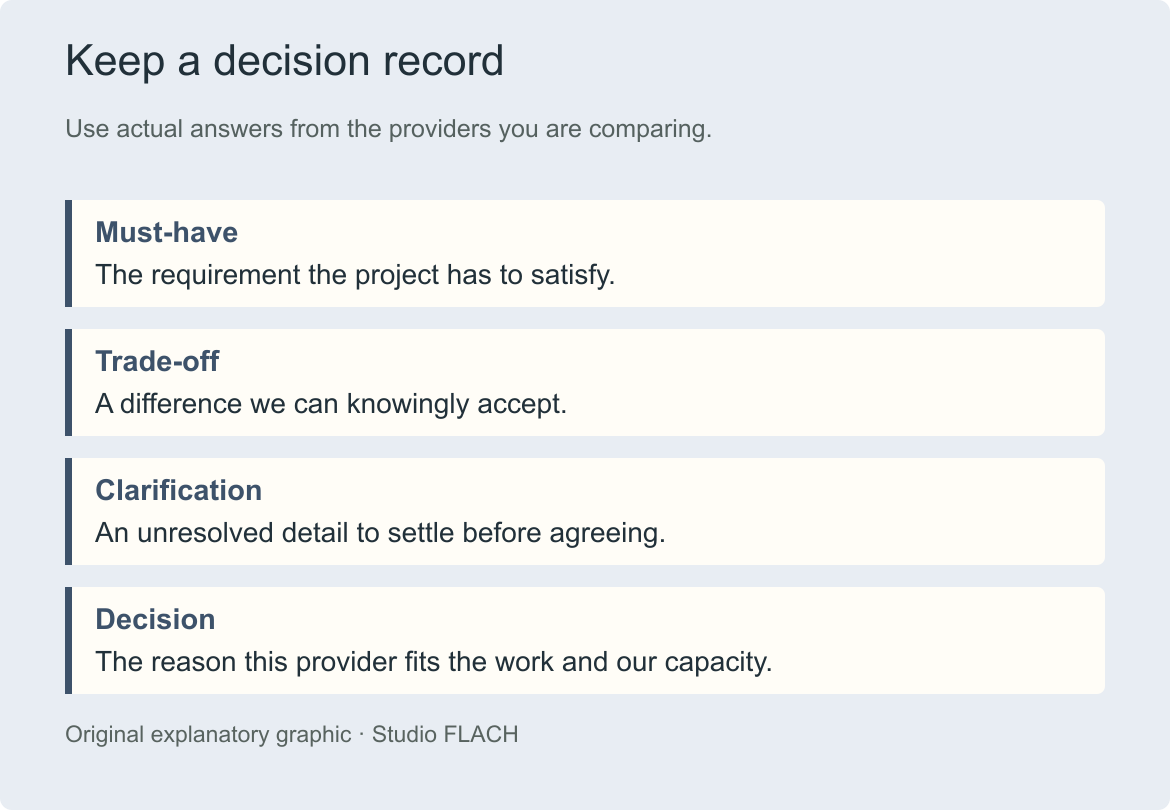
Complete the decision record from actual answers. A strength in one area does not cancel an unresolved requirement elsewhere.
Avoid adding scores until you have decided what matters. An average can hide a decisive problem: a provider may have a strong portfolio but be unable to support the platform your team needs. Equally, a simple proposal may cover a modest job very well. Compare the fit, evidence, responsibilities, and total commitment together.
At Studio FLACH, the published pricing and scope provide a starting point for True Space. The project proposal defines the agreed work. Bring your comparison questions to that conversation so the page types, content responsibilities, launch tasks, and handoff are clear before the project begins.