

Can ChatGPT and Gemini understand what your business does?
Check whether your public business information supports accurate AI answers, and separate citations from visits and enquiries.

An AI answer can mention your business and still describe it badly. It may confuse your services, repeat an old offer, recommend you for the wrong kind of project or attach a source that does not support the recommendation. Being named is useful only when the description helps a suitable customer make a sound decision.
For a small service business, start with the information you control: what you do, who it is for, who delivers it, what supports your claims and how someone takes the next step. Make those facts easy for a person to verify on your website before trying to influence how an assistant repeats them.
This is a practical way to review that public information. It is not a method for guaranteeing a ChatGPT recommendation, a Gemini mention or a first-place search position.
Write down the facts an answer should get right
Create a short reference sheet using current, approved information. Include the business name and website, core services, intended customers, delivery area, people behind the business and the contact route. Add prices only when you publish them or have a deliberate public pricing policy.
Be precise about boundaries. “Website design for established service businesses” communicates a different offer from “digital marketing for every business.” If you do not provide a service, do not imply that you do because it sounds helpful to search engines. The same applies to geography: working remotely with clients in a country does not make the business a local office in every city there.
Identify a public source for each fact. A service description belongs on a service page. A person's experience needs an accurate biography. A project claim should have inspectable evidence or clearly stated limits. The exercise may expose an ordinary website problem before it exposes an AI problem.

Original explanatory visual by Studio FLACH. Open the image to view it at full size.
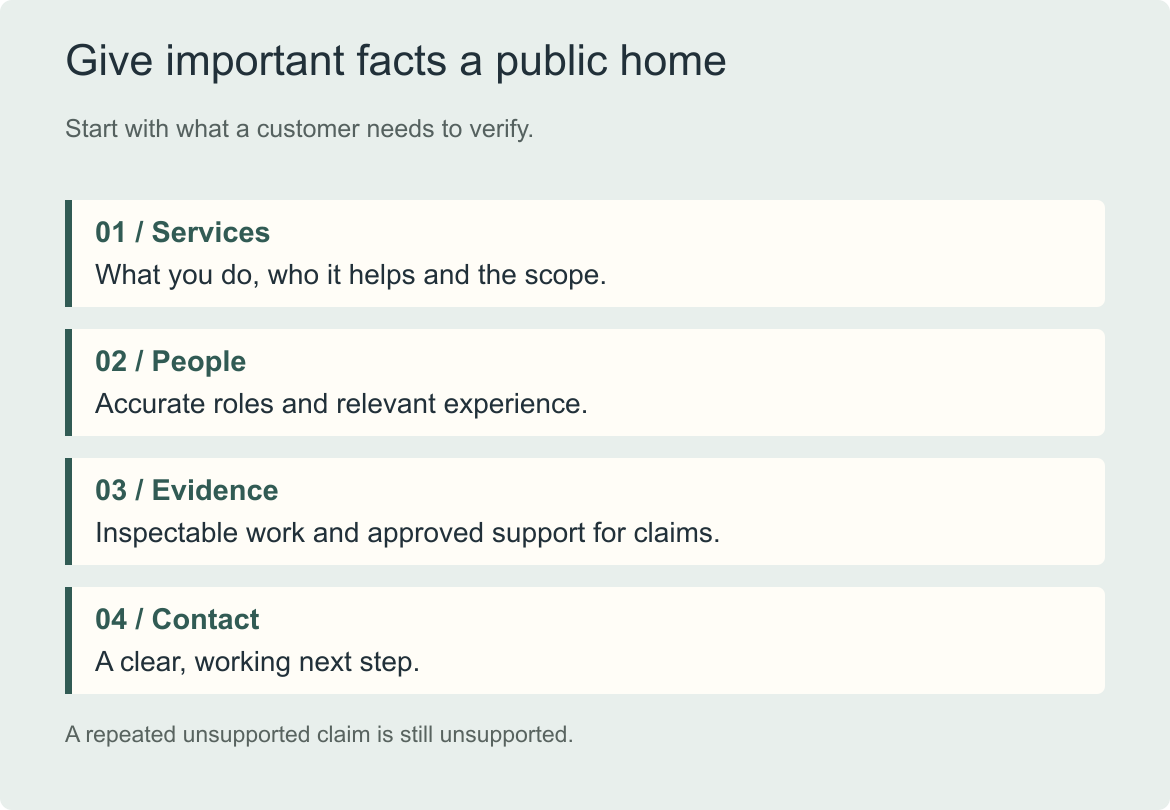
Each important fact should have a clear public home. Repeating an unsupported claim across more pages does not make it stronger.
Improve the pages buyers already need
Start with your most important service page. Can a new reader tell what the engagement includes, who it helps and what happens after an enquiry? Explain package names in ordinary language. A memorable name such as a named studio service still needs a descriptive explanation beside it.
Then inspect the supporting pages. Does the About page identify the actual people and relevant experience? Do case studies distinguish deliverables from measured outcomes? Does pricing explain scope and exclusions? Are testimonials used with accurate attribution and permission?
These changes have value even if an AI assistant never cites the page. They reduce the amount of interpretation a prospective customer needs to do. They also give outside sources a more reliable description to refer to.
For a broader structure, our consulting website design guide explains the decisions a prospective client needs to make before contacting a firm.
Check that important information is actually accessible
Ask your website provider whether the key content is available on public, indexable pages and whether internal links lead to it. An attractive explanation locked inside an image, a private document or an inaccessible interaction may be difficult for both visitors and automated systems to use.
Google's guidance for AI features in Search says the established SEO foundations remain relevant. It does not prescribe a special AI schema or additional technical requirement for AI Overviews and AI Mode. Those products are Google Search features; that guidance is not a guarantee about the Gemini app's answers.
For ChatGPT Search, OpenAI documents OAI-SearchBot separately from GPTBot . The former is used for search discovery; GPTBot concerns possible training use. Ask your developer to review the appropriate controls for your policy. Enabling a crawler does not establish that a particular answer will include your business.
You do not need to make these technical changes yourself. You need a provider who can explain the current settings, the content they affect and what remains uncertain.
Run a small, repeatable observation
Use two kinds of questions. First, ask a factual question about the named business, such as what it offers and who it works with. Compare the answer against your public reference sheet. This tests whether the assistant can assemble the right facts when you have already named the business.
Second, use a realistic discovery question without your name. A fictional example might be: “I run an established consulting practice in the United States. How should I choose a small studio for a brand and website project? Please use current web sources.” This tests a different task. An assistant finding your name after you supplied it is not evidence that it recommends you during unbranded discovery.
Record the exact prompt, date, engine and visible mode. Note relevant account or location conditions. If temporary or unpersonalized modes are available, they can reduce some influences, but do not describe the result as a controlled local ranking experiment. Accounts, products and answers still differ.

AI-generated illustrative photograph.
Illustrative generated photograph. The useful task is understanding and checking information, not collecting a screenshot of a favourable answer.
Read the citations, not just the summary
Open the sources that appear to support an important claim. A directory listing might explain how the assistant found a provider while offering little evidence for the recommendation itself. A service page may confirm an offer but say nothing about the revenue result attributed to it.
When you spot an error, identify the source before deciding what to change. Your website may contain an obsolete description. A third-party profile may need updating. Alternatively, the assistant may have misread accurate material. In that case, recording the error can be more appropriate than rewriting a clear page to chase one answer.
Keep legal and technical claims attached to the right jurisdiction and product. A guide to pricing rules in another country does not become suitable advice for your US business because an assistant cited it. A Google Search feature explanation should not be presented as a universal rule for every AI product.
Separate four different outcomes
An accurate description, a citation, a website visit and an enquiry are different observations. Track them separately:
Outcome: Accurate answer; What it tells you: The description matches the facts in that observation; What it does not establish: Consistent discovery across other questions
Outcome: Citation; What it tells you: A source link appeared in the answer; What it does not establish: That anyone clicked it
Outcome: Referral visit; What it tells you: An attributable visit reached the website; What it does not establish: That the visitor was a suitable prospect
Outcome: Qualified enquiry; What it tells you: A relevant person contacted the business; What it does not establish: That the AI mention caused every part of the decision
Small samples are still worth recording. They help you notice factual confusion and useful questions. They are not enough to announce a reliable mention rate, market share or ranking without a defined method and repeated observations.

Original explanatory visual by Studio FLACH. Open the image to view it at full size.
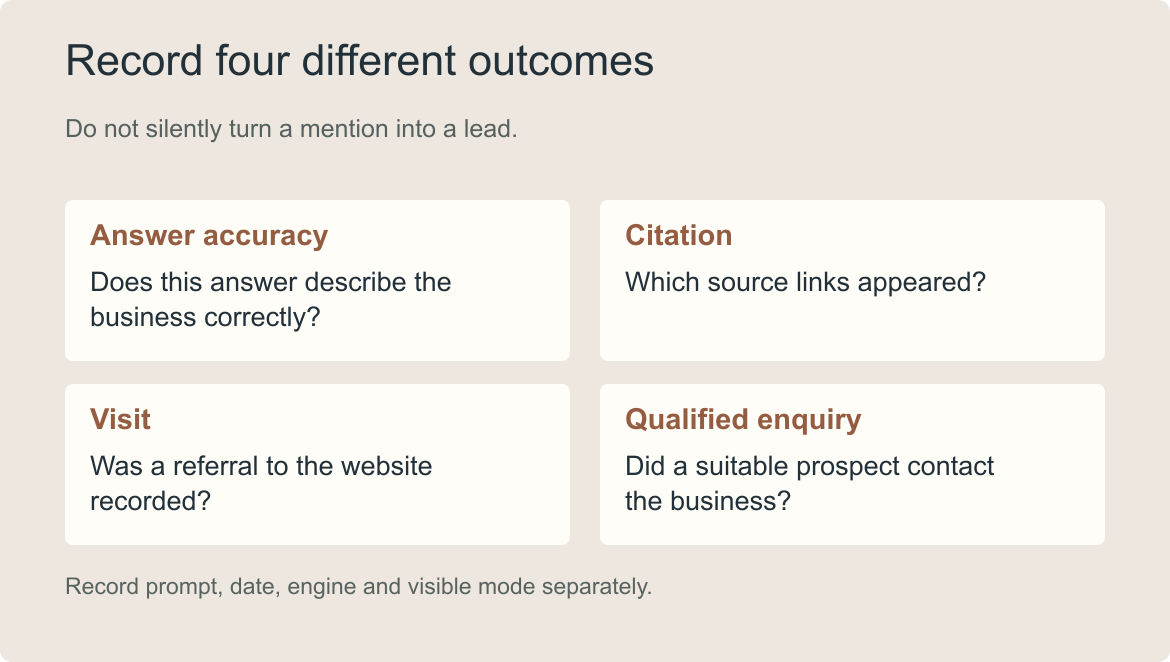
Keep each outcome in its own column so a mention does not quietly become a lead in the report.
Choose the next change for the reader
If a service is difficult to understand, clarify the service page. If buyers cannot assess experience, improve the approved proof. If a public profile is wrong, correct that profile through its normal process. Publish a new article when there is a genuine question to answer, not simply because one assistant omitted your name.
At Studio FLACH, True Space covers website planning, content direction, design and development. A useful starting point is a review of the facts, pages and customer decisions the site needs to support. The practical aim is an accurate, useful business presence that people can understand and sources can describe responsibly.