
Most businesses skip brand strategy entirely.
They jump straight to logos, colors, fonts. They want something that "looks professional" or "feels modern." And designers, eager to please, often oblige.
The result? A brand that looks fine but says nothing. A visual identity disconnected from the business it represents.
This is why we start every brand identity project with Strategic Clarity. Before we open a design file, we spend time understanding the business, its audience, and the gap it fills in the market.
Here's what that process actually looks like.
The goal is alignment, not decoration
A brand strategy session isn't a creative brainstorm. We're not throwing paint at a wall to see what sticks.
The goal is to answer a specific set of questions:
- What does this business actually do, and for whom?
- What problem does it solve better than alternatives?
- How should people feel when they encounter this brand?
- What's the one thing we want someone to remember?
These questions sound simple. They're not. Most business owners have never articulated the answers clearly. They operate on instinct, which works until you need to communicate that instinct to a designer, a copywriter, or a potential client.
What we cover in Strategic Clarity™
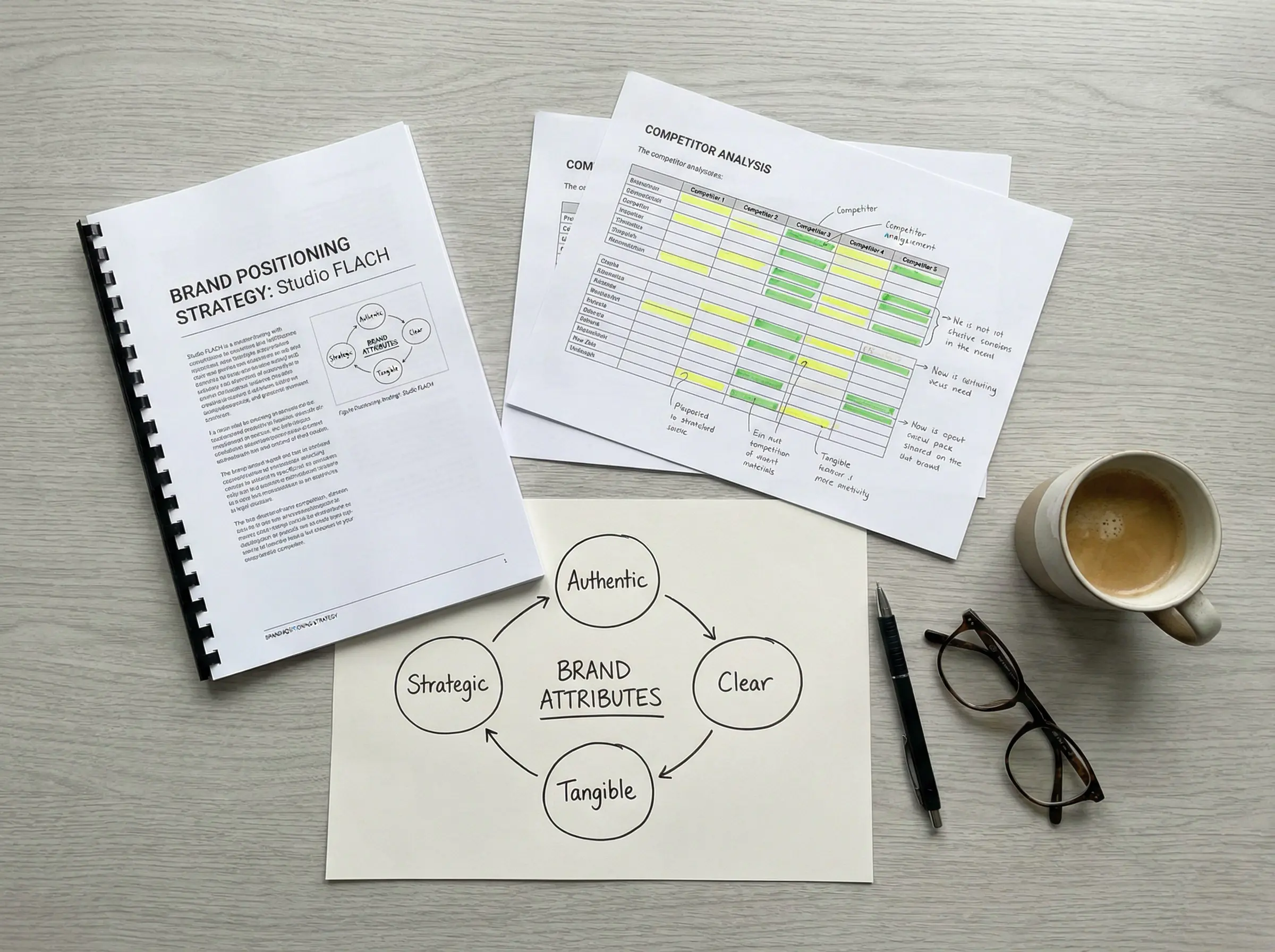
Our process moves through several distinct phases:
1. Discovery and intake
Before we meet, clients complete a detailed questionnaire. We want to know about their business model, their ideal clients, their competitors, and their own perception of their brand. We also ask what's working and what isn't.
This isn't busywork. The questionnaire forces clarity. Clients often tell us that filling it out was valuable on its own because it made them articulate things they'd never written down.
2. Competitive and market research
We study the landscape. Who else serves this audience? How do they position themselves? What visual language dominates the industry?
This research reveals patterns. Every industry has visual defaults: the tech startup gradient, the law firm navy blue, the wellness brand sage green. Knowing these patterns helps us decide whether to lean into them or break from them intentionally.
3. Audience definition
"Everyone" is not a target audience. Neither is "small business owners" or "people who want quality."
We push for specificity. Who is the person most likely to hire this business? What do they care about? What objections do they have? What language do they use?
This matters because a brand isn't what you say about yourself. It's what your audience perceives and remembers. If we don't understand the audience, we're designing blind.
4. Positioning and differentiation
Here's where we identify the gap. What makes this business different? Not "better." Different.
Every market has existing players. Some compete on price. Some compete on speed. Some compete on prestige. The question is: where does this business fit, and how do we communicate that position visually and verbally?
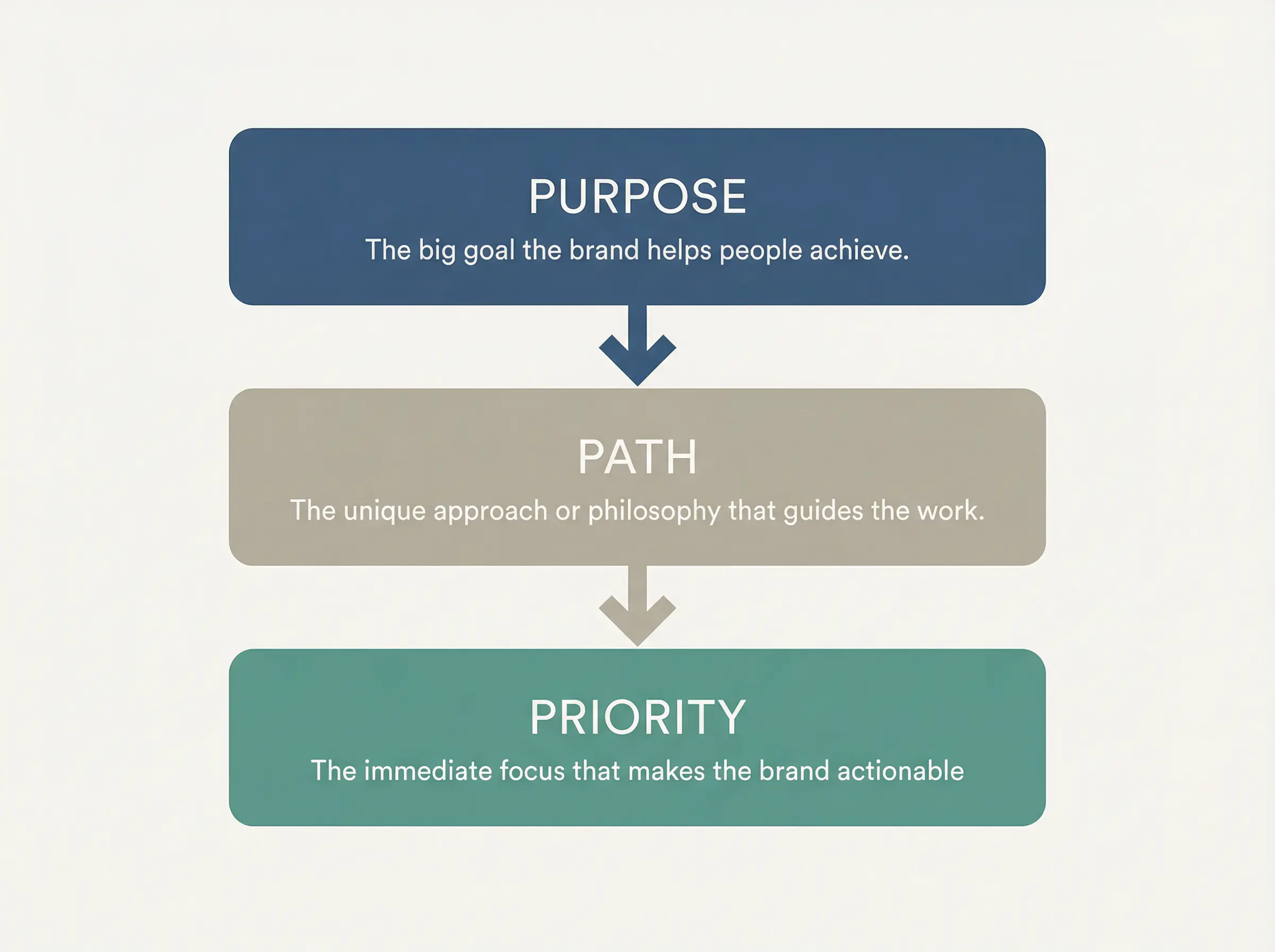
From your knowledge base, there's a useful framework here: Purpose, Path, Priority. Purpose is the big goal the brand helps people achieve. Path is the unique approach or philosophy that guides the work. Priority is the immediate focus that makes the brand actionable.
When we can articulate all three, the brand has direction.
5. Brand attributes and tone
We define three to five words that should describe how the brand feels. Not what it does. How it feels.
These words become a filter for every design decision. If one attribute is "approachable," we won't choose a typeface that feels cold or intimidating. If another is "precise," we won't use loose, hand-drawn illustrations.
We also identify what the brand is not. This is equally important. A brand that tries to be everything becomes nothing.
6. Strategic direction
By the end of this phase, we produce a document that captures everything above. This becomes the foundation for design. Every logo concept, color choice, and typographic decision ties back to this strategy.
Without it, design becomes a guessing game. With it, design becomes a series of informed decisions.
Why this matters for the work that follows
A brand identity built on strategy does three things:
It communicates clearly. When design decisions are rooted in positioning, the brand says something specific. Visitors to your website or recipients of your business card get an impression that matches who you actually are.
It resonates with the right people. A brand aimed at everyone attracts no one. A brand aimed at a specific audience, with their problems and aspirations in mind, creates recognition. People see themselves in it.
It lasts. Trends come and go. A brand built on strategy isn't chasing trends. It's built on something more durable: a clear understanding of the business and its place in the market. This means fewer redesigns, less second-guessing, and more confidence in how you present yourself.
The cost of skipping this step
We've seen it many times. A business invests in a logo and brand identity, skips the strategy, and six months later feels like something is off. The brand doesn't feel like them. It doesn't resonate with clients. It looked good in the mockups but doesn't translate to the real world.
This isn't a design failure. It's a clarity failure. The designer delivered what they were asked to deliver. But nobody asked the right questions first.
Strategy is the insurance policy against this outcome.

What clients say about the process
The most common feedback we hear isn't about the final deliverables. It's about the process itself.
Clients describe feeling like they finally understand their own business. Like they can now articulate what makes them different. Like the strategy session gave them language they didn't have before.
One client said it felt like therapy. That might sound dramatic, but there's truth in it. Clarity about your business often requires clarity about yourself: what you care about, who you want to serve, and why you do the work.
Is strategy always necessary?
For a quick logo refresh or a small project, maybe not. But for any business investing in a complete brand identity, strategy is the difference between a brand that works and a brand that just exists.
We build it into every True Mark project because we've seen what happens without it. And we've seen the difference it makes when it's done well.

