
Six words that make most designers tense up.
"I'll know it when I see it."
It comes up in almost every creative project at some point. A client looks at a concept, pauses, and says some version of it. Maybe it's "this doesn't feel right yet." Maybe it's "I like it, but something's off." Maybe it's the full, unfiltered phrase.
And here's the thing: they're almost always right. Something is off. They just don't have the vocabulary to say exactly what.
That's not a failure of communication. That's a completely normal response from someone who doesn't spend their days thinking about kerning, color theory, and visual hierarchy. They hired a design studio precisely because that's not their job.
The real question isn't whether clients will have vague reactions. They will. The real question is whether your process can do something useful with those reactions.
Ours can. Here's how.
Why This Phrase Gets a Bad Reputation
In creative circles, "I'll know it when I see it" has become shorthand for a nightmare client. The kind who can't make decisions, keeps changing direction, and sends you through fifteen rounds of revisions with no end in sight.
But that reputation is misplaced. The phrase itself isn't the problem. The absence of a process to interpret it is the problem.
When a client can't articulate what they want, one of two things is usually true:
- They haven't been given enough context to react clearly. They're looking at a design in a vacuum, without understanding the strategy behind it or the alternatives that were considered.
- They're responding to a real misalignment they can feel but can't name. Maybe the tone is wrong. Maybe the visual weight doesn't match their brand's personality. Their gut is picking up on something specific, even if their words aren't.
Both of these are solvable. Neither requires the client to become a designer overnight.
How We Turn Gut Reactions Into Clear Direction
Our process is built to prevent the "endless revision loop" before it starts. That doesn't mean we avoid feedback. We actively seek it. But we create conditions where feedback becomes useful instead of circular.
Strategy comes before design. Always.
Every Studio FLACH project that involves brand identity or web design starts with research and positioning through our Strategic Clarity™ process. Before anyone opens a design tool, we've already answered the questions that matter:
- Who is this brand speaking to?
- What does the business actually need this brand (or website) to do?
- What should someone feel in the first few seconds of encountering it?
- Where does this business sit relative to its competitors?
This groundwork changes the entire feedback conversation. When a client sees a design concept that was built on shared strategic decisions, they're not reacting in a vacuum. They're evaluating whether the design delivers on goals they helped define. That's a completely different starting point.
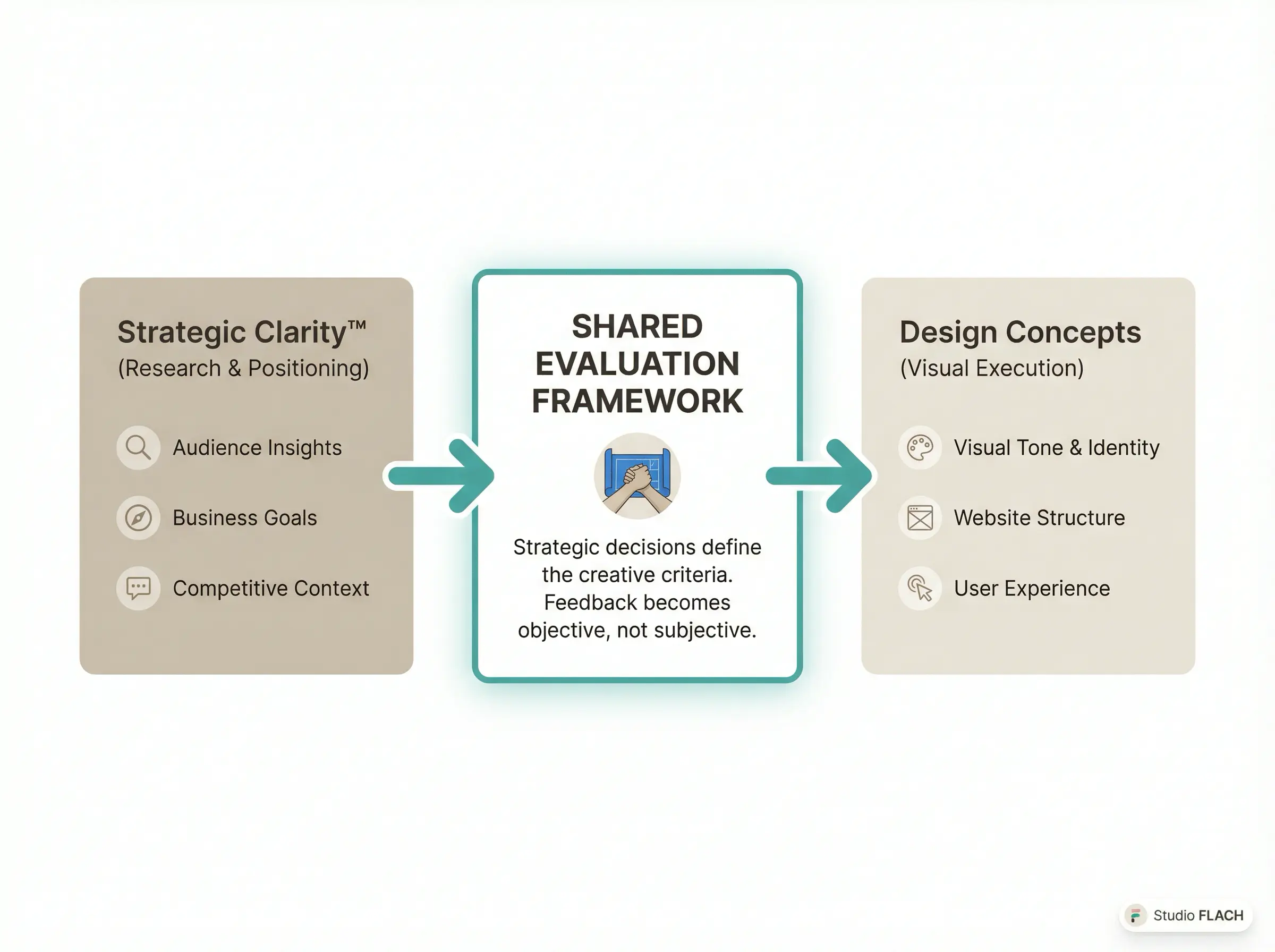
We present work with reasoning, not just visuals
When we share a design direction, it never arrives as a bare image with "thoughts?" attached. Every concept comes with a clear explanation of the choices behind it. Why this color palette. Why this typographic approach. Why this layout structure.
This matters because it gives clients a framework for their reaction. Instead of "I don't like it" (which tells us very little), the conversation shifts to "I understand why you went with a serif typeface for authority, but my audience skews younger and I wonder if that's the right tone." That's actionable. We can work with that in one round, not four.
Feedback is guided, not open-ended
Asking a client "what do you think?" is setting both sides up for frustration. It's too broad. The response will be too broad, too.
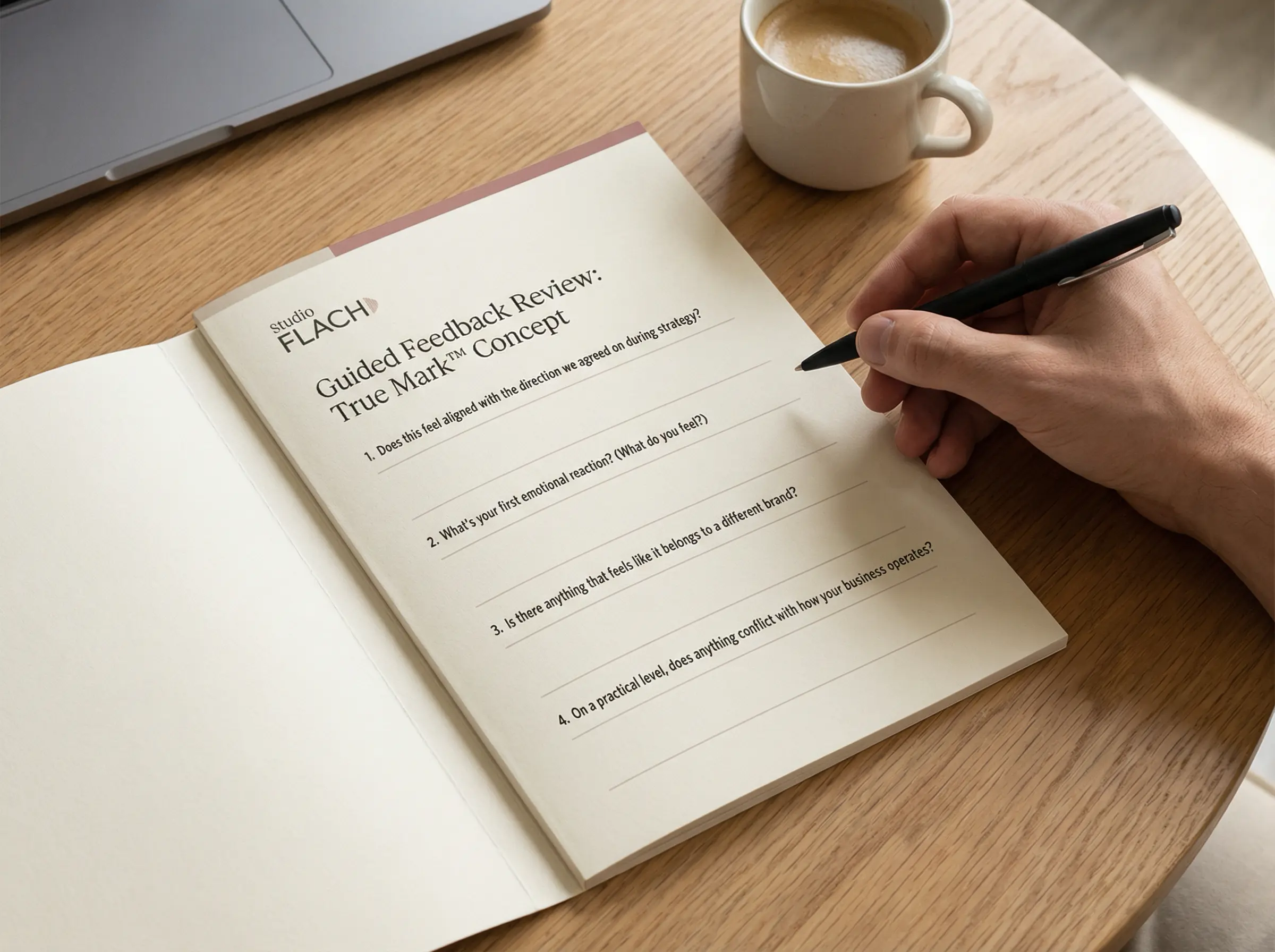
We ask specific questions during every review:
- Does this feel aligned with the direction we agreed on during strategy?
- What's your first emotional reaction? (Not whether it's "good" or "bad." What do you feel?)
- Is there anything that feels like it belongs to a different brand?
- On a practical level, does anything conflict with how your business operates?
These questions do the translation work for the client. They don't need to speak in design terms. They just need to react honestly within a structure that helps us pinpoint exactly where the disconnect lives.
Revisions are focused, not open-ended
Once we've collected feedback through guided questions, we don't just go back to the drawing board and hope for the best. We summarize what we heard, confirm the specific changes we're making, and explain what will stay the same and why.
This keeps the project moving forward in a straight line instead of spiraling. Every revision round has a clear scope and a clear goal. The client always knows what's changing, what to look for in the next version, and how close we are to the finish line.
What "Good Feedback" Actually Looks Like
Clients sometimes worry they're giving bad feedback. They'll apologize for not being more specific, or they'll over-explain to compensate.
Here's what we tell every client at the start of a project: your honest, unfiltered reaction is the most valuable thing you can give us. We'd rather hear "something feels off about this, I can't put my finger on it" than a client forcing themselves to say it's fine when it isn't.
A few examples of feedback that's more useful than people think:
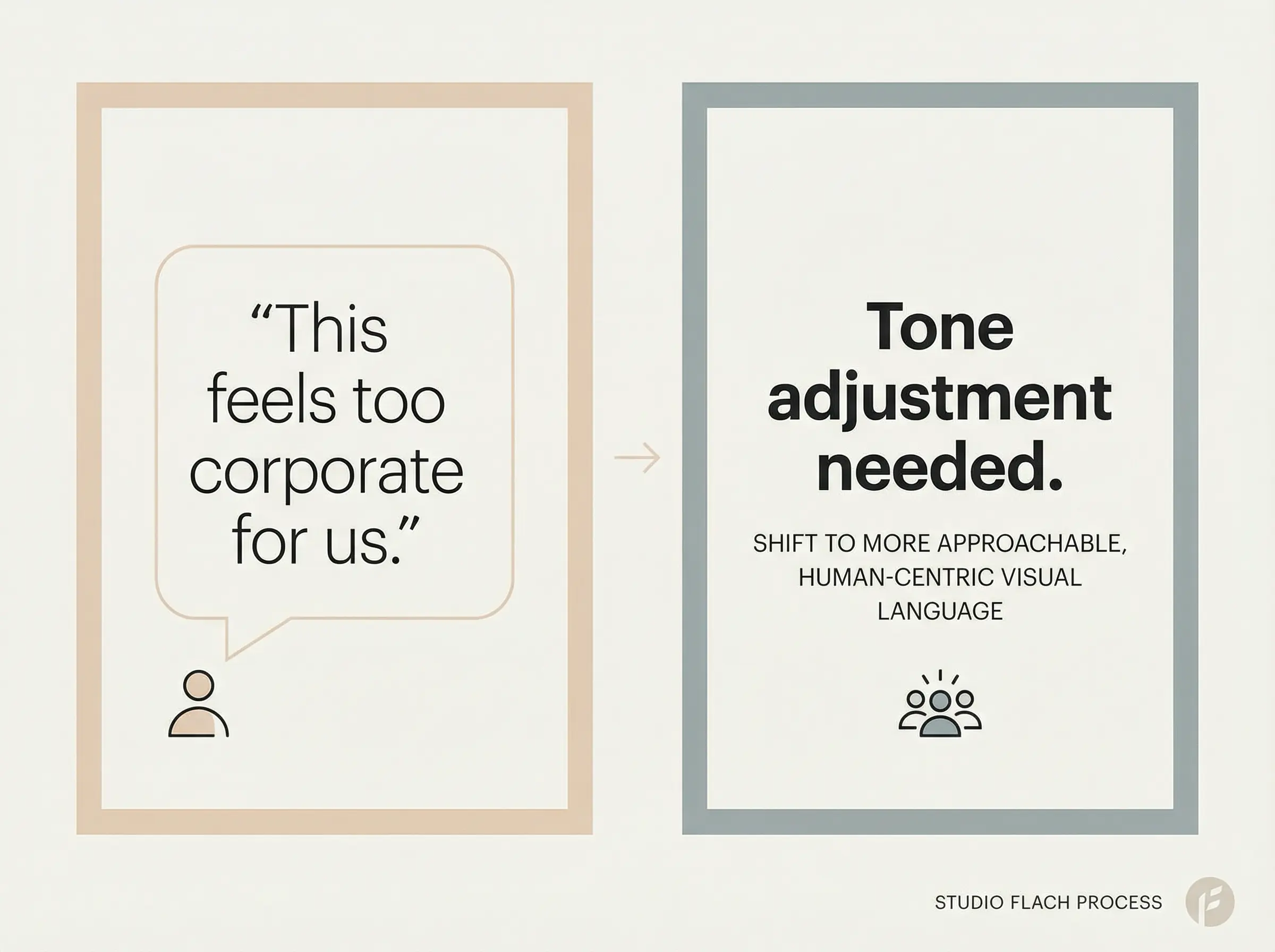
- "This feels too corporate for us." (That tells us the tone is wrong. We can adjust.)
- "I keep looking at the left side of the page and ignoring the right." (That tells us the visual hierarchy needs reworking.)
- "I love this, but I'm worried my clients won't get it." (That tells us there might be a gap between the brand's personality and its audience's expectations.)
- "My competitor's site gives me a similar vibe." (That tells us we need more differentiation.)
None of these require design expertise. All of them give us exactly what we need to make the next version better.
The Real Outcome
Clients who go through our process don't end up saying "I'll know it when I see it" over and over. They say it once, maybe twice, early on. Then the structure kicks in.
By the time we're in the later stages of a project, clients are giving precise, confident feedback because they understand the strategy, they've been part of the decisions, and they trust the process enough to say what they actually think.
That's what people are describing when they call working with us "genuinely collaborative." It's not a buzzword. It's what happens when a process is designed to make the client's instincts useful from day one.
"I'll know it when I see it" isn't a red flag. It's a starting point. And with the right process, it only needs to be said once.

