
There's a Gap Nobody Talks About
You need a brand. Or a website. Or both.
So you start looking. And almost immediately, you run into the same fork in the road every growing business faces: hire a freelancer or hire an agency.
Freelancers are affordable. Agencies are impressive. Both options look reasonable on paper. But once you're deep into a project, the cracks show up fast.
The freelancer gets busy with other clients and your project stalls for two weeks. Or the agency assigns your account to a junior designer you've never spoken to, and suddenly you're paying premium rates for work that doesn't match the pitch.
This isn't a rare experience. It's the default experience for most businesses shopping for branding and web design help.
The problem isn't that freelancers are bad or that agencies are incompetent. The problem is that neither model was designed for what most businesses actually need: high-quality work, done by senior people, with clear communication and a process that doesn't drag on for months.
That gap in the middle? We call it the branding dead zone.
The Freelancer Trap
Freelancers are appealing for obvious reasons. Lower cost. Faster turnaround (in theory). Direct communication with the person doing the work.
But the model has structural weaknesses that show up once the project gets real:
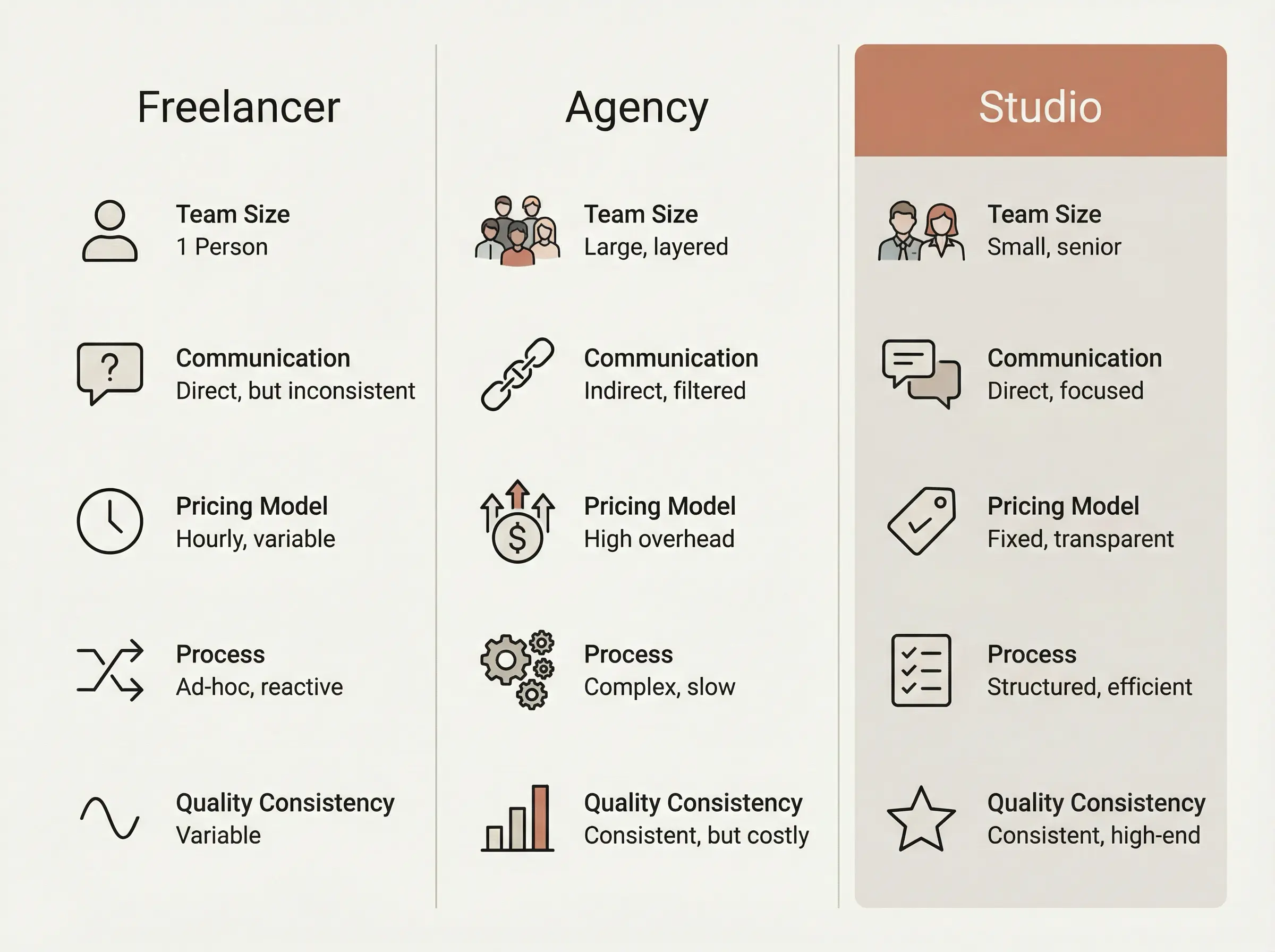
- Inconsistency. A freelancer juggling five or six clients at once can't give your project the same attention every week. Quality fluctuates. Timelines slip.
- Limited range. Most freelancers specialize in one thing. You might get a great logo, but then need a separate person for the website, another for the brand guidelines, and someone else for ongoing updates. Now you're managing a team you never wanted to manage.
- No process. Many freelancers work reactively. They wait for direction instead of leading the project. That puts the strategic burden on you, the client, which is exactly what you were trying to avoid by hiring help.
- Availability risk. Freelancers get sick. They take vacations. They land a bigger client and quietly deprioritize your project. There's no backup.
None of this makes freelancers bad people. It makes freelancing a tough model to scale with any reliability.

The Agency Problem
Agencies solve some of those issues. They have teams, processes, project managers, and enough capacity to keep your project moving even if one person is out.
But they introduce a different set of frustrations:
- Cost. Agency overhead is real. Office space, account managers, department heads, admin staff. All of that gets baked into your quote. A project that might cost 10K with a focused team can balloon to 30K or $50K at an agency, often without a proportional jump in quality.
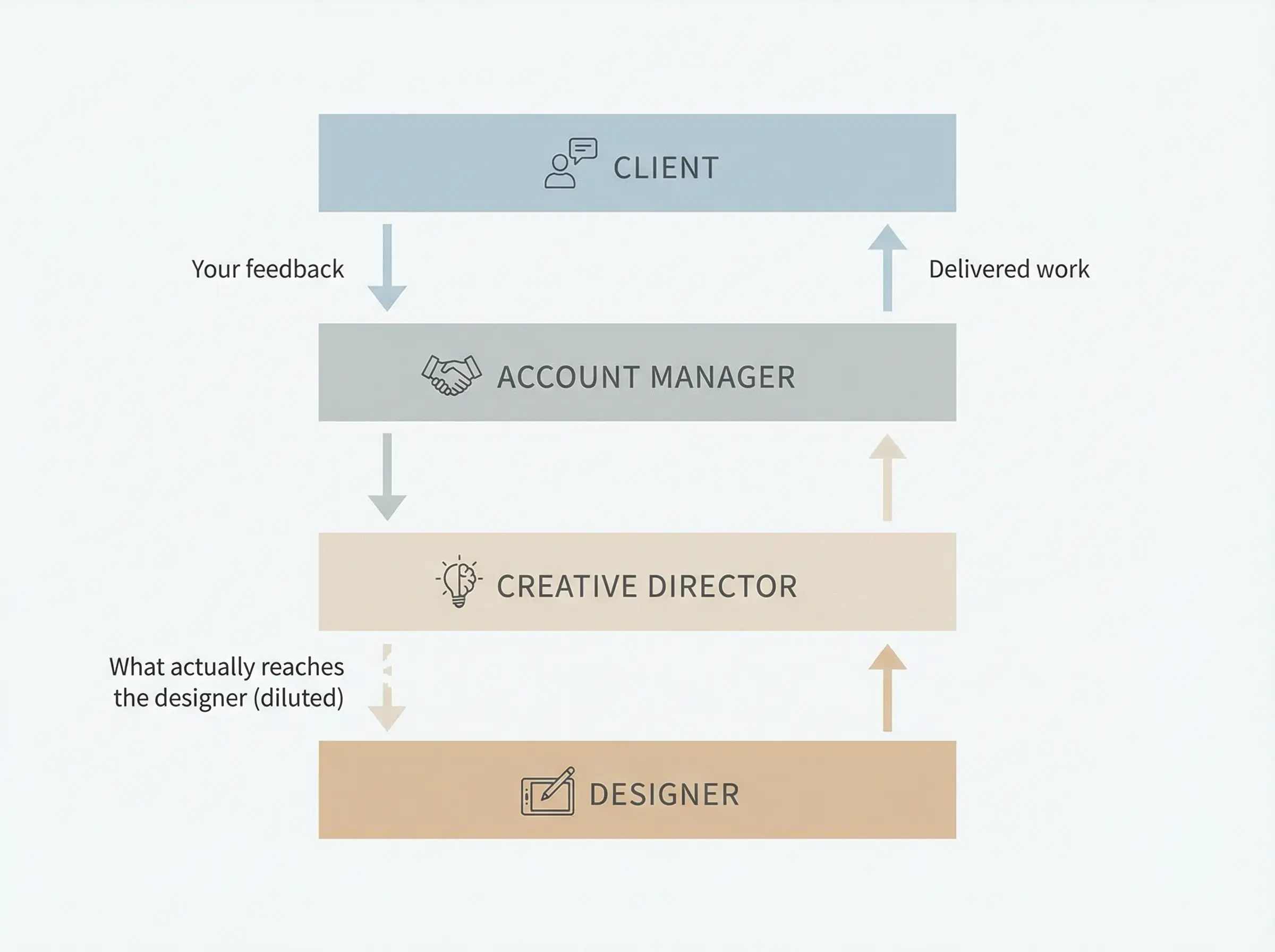
- Layers. You tell the account manager. The account manager tells the creative director. The creative director tells the designer. Your feedback goes through the same chain in reverse. By the time your notes reach the person actually doing the work, something has been lost.
- Slow decisions. More people means more meetings. More approvals. More "let's circle back on that." A project that should take six weeks takes four months.
- Junior execution. The senior team sells the project. The junior team builds it. This is standard practice at most mid-to-large agencies, and it's the single biggest source of client disappointment.
You're paying for expertise. You deserve to work with the people who actually have it.
What Businesses Actually Need
When we talk to potential clients, the wish list is remarkably consistent. It doesn't change much from industry to industry, company size to company size.
What they want is simple:
- Work done by experienced people, not handed off to someone they've never met
- A clear process with defined steps, timelines, and deliverables
- Direct communication with the people making decisions
- Professional-quality output that holds up against anything an agency would produce
- Pricing that makes sense and doesn't change halfway through
That's it. No one is asking for a 47-slide strategy deck or a Slack channel with 14 people in it. They want good work, a smooth experience, and confidence that the result will actually move their business forward.
The Studio Model
This is why the studio model exists.
A studio operates with a small, senior team. No layers between the client and the people doing the work. No bloated overhead driving up costs. No revolving door of junior designers learning on your dime.
At Studio FLACH, that looks like this:
- Two founders, both senior. Lucas and Stephanie handle every project directly. You're not being passed to an associate or a subcontractor.
- A structured process from day one. Every engagement follows a clear path: discovery, strategy, design, launch, and (if needed) ongoing support. No ambiguity about what happens next or when.
- Fixed pricing. You know the cost before the project starts. No hourly billing surprises. No scope creep negotiations. The price is the price.
- Full-service capability without the full-service price tag. Strategy, brand identity, web design and development, and ongoing support, all under one roof.
The work is high-end. The experience is personal. And because the team is small and focused, nothing gets lost in translation.
How to Know You're in the Dead Zone
If any of these sound familiar, you're probably stuck in the gap:
- You've hired two or three freelancers for the same type of work in the past year and none of them felt like a long-term fit
- You got a quote from an agency and the number felt disconnected from the scope
- Your brand was "done" months ago but still feels unfinished because no one is maintaining it
- You're spending time managing your creative partners instead of focusing on your business
- The quality of your brand materials varies depending on who made what and when
These aren't signs that you're too picky. They're signs that the model is wrong.
Finding the Right Fit
Not every business needs a studio. If you need a single logo and your budget is $500, a freelancer is the right call. If you're a Fortune 500 company running a global rebrand across 40 markets, you need an agency with that infrastructure.
But if you're a growing business that takes its brand seriously, needs senior-level thinking and execution, and doesn't want to waste time or money on a process that wasn't built for you, the studio model is worth a serious look.
The branding dead zone exists because most businesses don't know there's a third option. Now you do.

