
Your team asks: "How should we sound?" You answer: "Make it friendly, but professional. And human."
You have just given them nothing.
"Friendly" means something different to a 22-year-old social media manager than it does to a 45-year-old sales director. The result is inconsistency. The result is a brand that sounds like five different people having an argument.
To scale your brand voice, you must move beyond adjectives. You need rules. You need constraints. You need examples.
The Problem with Adjectives
Adjectives are subjective. They require interpretation. Interpretation leads to drift.
Effective guidelines are objective. They describe actions, not feelings.
- Weak: "Be concise."
- Strong: "Never use a sentence longer than 20 words in a headline. Cut all adverbs."
The 4 Components of a Functional Voice Guide
We use this structure at Studio FLACH to build guides that actually work.
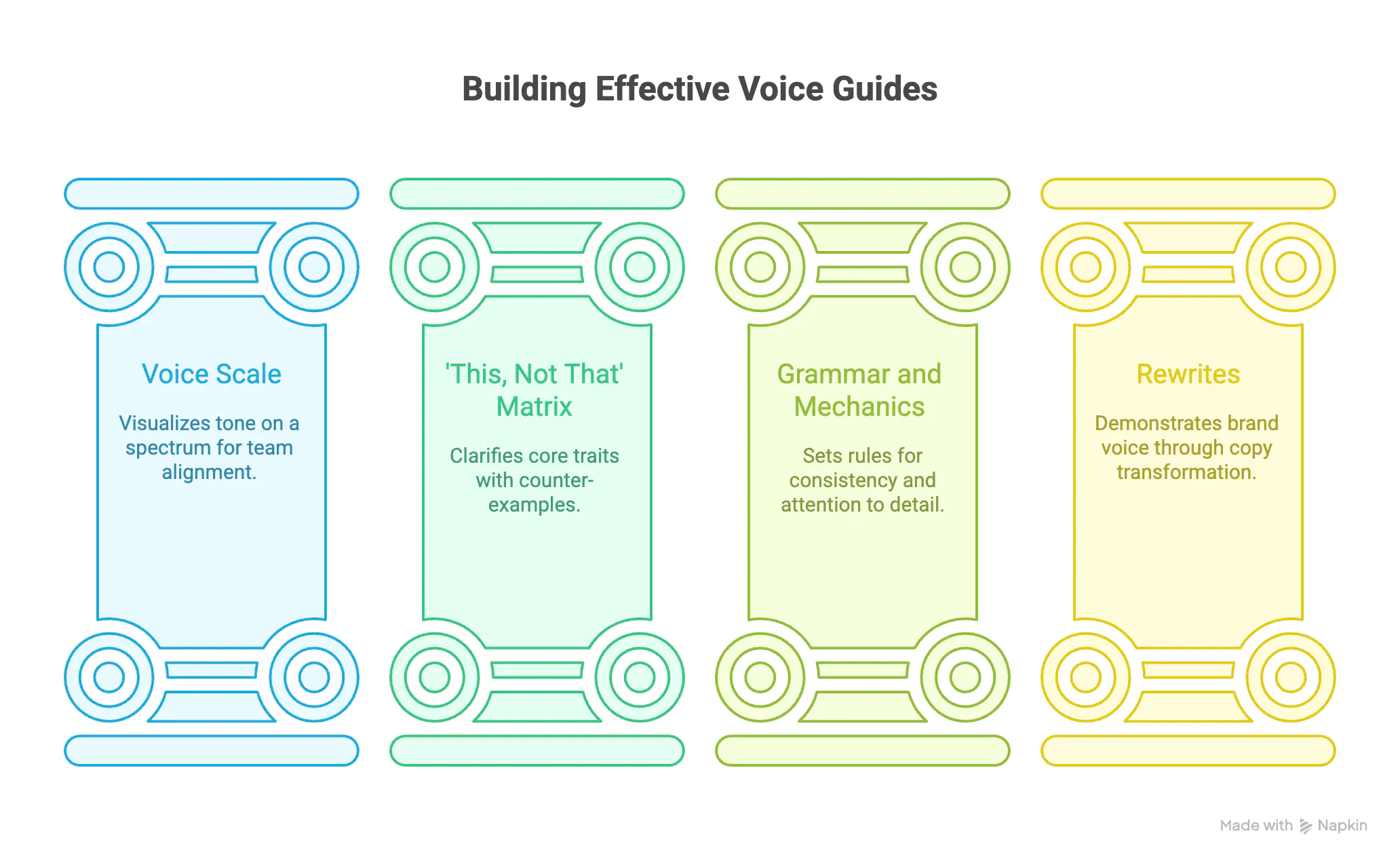
1. The Voice Scale
Visualize your tone on a spectrum. Place a marker where you sit.
- Formal <--------|----> Casual
- Serious <---|--------> Playful
- Respectful <-------|----> Irreverent
- Direct <----|--------> Descriptive
This gives your team a visual anchor. They know exactly how far they can push.
2. The 'This, Not That' Matrix
This is the most valuable page in the document. Take your core traits and clarify them with counter-examples.
- We are Expert.
- This means: We use data. We have strong opinions. We guide the reader.
- This does NOT mean: We use jargon to sound smart. We talk down to the audience. We are rigid.
3. Grammar and Mechanics
Do not leave this up for debate. Set the rules.
- Do we use the Oxford Comma? (Yes).
- Do we use emojis? (Only on social, never in email).
- Do we capitalize headlines? (Sentence case only).
Consistency in mechanics signals attention to detail.
4. The Rewrites
Show, do not just tell. Take a generic piece of copy and rewrite it in your brand voice. Explain why you made the changes.
- Original: "We provide comprehensive solutions to help you optimize your workflow."
- Rewrite: "We help you work faster."
- Notes: We removed the jargon. We focused on the benefit. We made it active.
Implementation is Everything
A PDF buried in a Google Drive folder is useless.
Make your guide a living document. Print it out. Tape the "This, Not That" list to the wall. Review it during onboarding.
When you critique copy, reference the guide. Say, "This feels too formal according to page 4," rather than "I don't like this."
A clear voice guide gives your team confidence. It sets boundaries so they can play. It ensures that no matter how big you get, you still sound like you.

